


In the Yukon, your paycheque is affected by two levels of income tax: federal tax and territorial tax. The federal rates go from 14% to 33%, while Yukon rates range from 6.4% to 15%. What makes the Yukon attractive is its simple system, with no sales tax, health premiums, or high-income surtax. The second-highest tax rate of 12.8% applies to income up to $500,000. Residents also receive benefits such as Northern Residents Deductions and other local tax credits.
You can also increase your earnings by recovering some of your taxes by claiming the Basic Personal Amount, RRSP deductions, CPP and EI tax credits, the Northern Residents Deductions, and Yukon-specific credits and benefits such as the Yukon Child Benefit, First Nations Income Tax Credit, Business Investment Tax Credit, Political Contributions Tax Credit, and the newer fertility and surrogacy tax credit.
The sections below guide you from the specific bracket rates to what makes the Yukon unique, as well as practical steps to help you retain more of every dollar you earn.
How Much is Your Income Tax on Yukon Employment Earnings in 2026
In Yukon, local tax is added to federal tax, plus deductions for the Canada Pension Plan and Employment Insurance. This means your take-home pay can differ significantly from your total salary.
The tool below uses the 2026 federal and Yukon tax rates, plus the current CPP and EI rates, so you can see exactly how much is taken out and how much you keep from every dollar you earn.
To get started, enter your employment income, choose your pay frequency, and include any additional amounts such as bonuses, vacation pay, or RRSP contributions. Then, review your gross-to-net breakdown below.
What are the Territorial and Federal Income Tax Rates in Yukon?
Residents of Yukon pay two layers of income tax on the same return: federal tax, set by the Government of Canada, and territorial tax, set by the Yukon government. Both layers use a progressive structure, meaning your income is divided into brackets, and each bracket is taxed at its own rate. Only the portion of income that falls into a higher bracket is taxed at that higher rate.
Find a breakdown of the federal and territorial tax brackets to clearly show which rate applies to each portion of your income below.
Federal Tax Brackets
Residents of Yukon are subject to federal income tax with five brackets, ranging from 14% (the full-year rate for 2026) to 33%.
The list below outlines the federal tax brackets and their 2026 thresholds.
- 14% on the income up to $58,523
- 20.5% on the income over $58,523 to $117,045
- 26% on the income over $117,045 to $181,440
- 29% on the income over $181,440 to $258,482
- 33% on the income over $258,482
The 14% lowest rate is a recent update. In 2025, the lowest rate was 14.5%, but from July 2025 onward, it was 14% for part of the year. From 2026 onward, the 14% rate applies for the entire year.
Yukon Tax Brackets
Unlike some provinces that add extra taxes on top of the basic rates, Yukon does not charge extra taxes for individuals or high earners. Yukon’s tax system has five income tax rates, ranging from 6.4% to 15%. It mirrors the federal bracket thresholds, so the first three tax levels line up exactly with the federal ones, all of which are increased by 2.0% for 2026.
Here are the full territorial tax rates for each level:
- 6.4% on the income up to $58,523
- 9% on the income over $58,523 to $117,045
- 10.9% on the income over $117,045 to $181,440
- 12.8% on the income over $181,440 to $500,000
- 15% on the income over $500,000
Source: Payroll Deductions Tables – CPP, EI, and income tax deductions – Yukon – Government of Canada
Combined federal and Yukon marginal tax rates by income types
The combined marginal tax rate shows the real tax you pay on your next dollar of income after adding both federal and Yukon territorial taxes, which changes a lot depending on your income level and the type of income you receive.
For regular income such as wages, interest, and similar earnings, the combined rate starts at 20.40% for the lowest income group and rises to 48% for income over $500,000. Capital gains are taxed at half these rates because only half of a capital gain is counted as taxable income.
Eligible dividends are taxed at the lowest rates and can even result in a negative tax rate of -9.16% for the lowest income group due to dividend tax credits. Non-eligible dividends are taxed at a rate between the regular income and eligible dividend rates, with a 12.30% rate in the lowest bracket.
The following table shows the combined marginal rates for each additional dollar of income, by income type, for 2026:
| 2026 taxable income | Other income (employment, interest, etc.) | Capital gains | Eligible dividends | Non-eligible dividends |
| First $58,523 | 20.40% | 10.20% | -9.16% | 12.30% |
| Over $58,523 to $117,045 | 29.50% | 14.75% | 3.40% | 22.77% |
| Over $117,045 to $181,440 | 36.90% | 18.45% | 13.61% | 31.28% |
| Over $181,440 to $258,482 | 42.22% | 21.11% | 20.95% | 37.39% |
| Over $258,482 to $500,000 | 45.80% | 22.90% | 25.89% | 41.51% |
| Over $500,000 | 48% | 24% | 28.93% | 44.04% |
There are two main reasons to examine Yukon’s combined rates:
First, different types of income are taxed at very different rates: capital gains are taxed at half the rate of ordinary income (because only half is included), and eligible dividends are taxed at a lower rate due to the dividend tax credit.
Second, the 42.22% income rate for the range of $181,440 to $258,482 is slightly higher than the usual 41.8% because the extra federal and Yukon Basic Personal Amounts begin to reduce in this income range. When taxable income exceeds $258,482, the tax rate rises to 45.8% and remains there until it reaches Yukon’s highest bracket, which starts at $500,000.
The table below illustrates how federal and Yukon combined marginal tax rates interact in real dollars, followed by detailed explanations:
| Scenario | What’s taxed at the margin | Rate on the next dollar | The takeaway |
|---|---|---|---|
| $60,000 salary | Income above $58,523 | ~29.5% | The average rate is far below the marginal rate once the BPA, CPP, and EI are applied. |
| $90,000 + $5,000 RRSP | The RRSP deduction | ~29.5% | The contribution saves about $1,475 at your marginal rate, not your average rate. |
| $120,000 + extra income | A $10,000 bonus vs. a $10,000 capital gain | 36.9% vs. ~18.45% | How income is earned affects the rate; dividends differ again due to the dividend tax credit. |
Real-World Example: $50,000 Salary in the Yukon
For a single Yukon employee making $50,000 before taxes in 2026 and only using the basic personal tax credit, the estimated take-home pay is about $40,611 a year. The income tax they pay is about $5,807. Other deductions include CPP payments of about $2,767 and EI payments of about $815.
The four mandatory deductions are:
| Deduction | Estimated 2026 Amount |
|---|---|
| Federal income tax | ~$3,985 |
| Yukon territorial tax | ~$1,822 |
| Canada Pension Plan (CPP) | ~$2,767 |
| Employment Insurance (EI) | ~$815 |
| Total deductions | ~$9,389 |
| Net (take-home) pay | ~$40,611 |
Be aware that these payments are not exactly taxes; CPP helps pay for your retirement later, and EI gives you benefits if you lose your job. Also, both CPP and EI create non-refundable tax credits, which is why your income tax is less than the official tax rates suggest.
In addition, Yukon tax bracket rates often do not reflect the actual amount of your salary that is taxed because of different credits and the basic personal amount, which lowers your taxes. This difference is easier to understand when you separate two key ideas: the total rate you pay on all your income and the rate that applies to each extra dollar you make.
The two rates that people often confuse are:
- Average Rate: This is about 11.6% for income tax, or about 18.8% when you add CPP and EI. It shows how much of your total $50,000 salary is deducted. This percentage is much lower than any single tax bracket rate because the basic personal amount lets you keep the first $16,452 tax-free, and your CPP and EI credits lower the taxable income even more.
- Marginal Rate: This rate is approximately 20.4% per additional dollar you earn. With a $50,000 income, you are in the first tax bracket (14% federal and 6.4% Yukon), so any additional dollar you make is taxed at around 20.4%.
What Makes Yukon Income Tax Different from Other Provinces and Territories?
Yukon’s territorial tax system is relatively straightforward, but its features can result in a different take-home pay than in many provinces. In short, four things that make Yukon different are that its tax rates are lower than the federal ones, it does not add extra taxes beyond the bracket rates, every community can claim the Northern Residents Deductions, and it provides several territorial credits that are easy to overlook.
The table below summarises these four features, and the notes that follow explain each one:
Example:
| Distinguishing Feature | What It Means for You |
|---|---|
| Brackets aligned with federal thresholds | Yukon’s first three bracket thresholds match the federal ones, so the lower end of your territorial and federal tax is easy to compare. The top two brackets differ: 12.8% applies up to $500,000, and 15% applies above that. |
| No surtax, sales tax, or health premium | Yukon charges no PST, no territorial health premium, and no high-income surtax. Your territorial tax is calculated solely from the bracket rates, with nothing added afterward. |
| Territory-wide Northern Residents Deductions | Every Yukon community sits in a prescribed northern zone, so most residents who meet the time requirement can claim this federal deduction, which a paycheque calculator will not reflect. |
| Often-missed territorial credits | Yukon offers the First Nations, Business Investment, and Political Contributions credits, plus children’s fitness and arts credits and newer refundable fertility and surrogacy credits. |
Most provinces apply their highest tax rate on every dollar earned over about $258,482. Yukon is different: it applies its second-highest tax rate of 12.8% up to $500,000 and charges only the top 15% rate on income above that amount.
If you earn $300,000, the roughly $41,500 you make between $258,482 and $300,000 is taxed at Yukon’s 12.8% rate (about 42.22% combined with federal tax) instead of the 15% top rate (about 48% combined).
This 2.2-point difference on $41,500 saves you just over $900 in territorial tax compared to a province where the top rate starts at $258,482. The closer your income gets to $500,000, the more you benefit from this lower rate, which is why high earners pay attention to Yukon’s tax system.
How to Keep More of Your Yukon Income With Tax Credits and Benefits
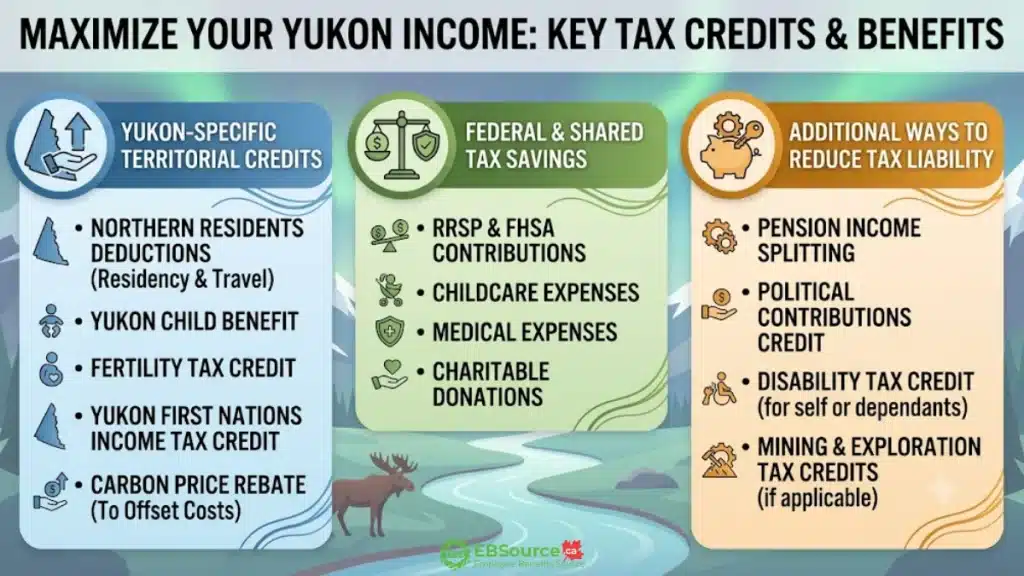
To keep more of your income in Yukon, you should focus on two key strategies: adjusting the amount withheld from each paycheque and claiming all the territorial credits and deductions for which you qualify when you file your taxes. It means that, first, you can ask the CRA to reduce the tax withheld from your paycheques. Second, it’s important to use the different credits and benefits available in Yukon that might not appear on a paycheque calculator.
Before you can claim anything back, it helps to see what your employer deducts from each paycheque, since some items lower your tax during the year and others only matter when you file.
The table below sorts the main items by how they affect you:
| Area | What’s Involved | What It Affects |
|---|---|---|
| Payroll withholding | CPP, CPP2, EI, federal tax, Yukon tax, TD1 forms | Your regular paycheque |
| Tax deductions | RRSP contributions, employment expenses, Northern Residents Deductions | Your taxable income at filing |
| Tax credits and benefits | Yukon Child Benefit, First Nations Income Tax Credit, Business Investment Tax Credit, Political Contributions Tax Credit | Your refund, balance owing, or monthly benefits |
The next sections explain how to ask for less tax to be taken from your paycheque, then cover Yukon-specific credits and benefits to think about before you file:
Ask the CRA to reduce the tax withheld from your pay
Your employer deducts CPP, CPP2, EI, federal income tax, and Yukon territorial tax from every paycheque, with income tax calculated using standard payroll tables. If you think the deductions or credits you qualify for are missing from these tables, you can ask the CRA to lower the tax taken out. This way, you get more money in each paycheque instead of waiting for a refund at the end of the year. To do this, you need to fill out Form T1213, which covers any deductions and non-refundable credits not already on your Form TD1.
The CRA will review your request and, if they agree, send you a letter of approval. You give this letter to your employer so they can reduce the tax taken from your pay. People often use this for regular RRSP contributions, deductible work-related expenses, or support payments.
A few things to remember: you usually have to send this request every year, and it does not change the total tax you owe for the year. It only changes when you get your money, so you get more each month instead of waiting for a refund later.
Know Yukon-specific tax credits and benefits that affect your paycheque
Besides these required deductions, understanding the right forms, deductions, and credits can help you keep more money during the year or lower the amount of tax you owe at the end.
Depending on your situation, several territorial credits and benefits can reduce your balance owing, increase your refund, or provide monthly support, and most will not appear in a paycheque calculator.
The table below groups them by the situation that makes you eligible:
| If You | You Should Check |
|---|---|
| Have children | Yukon Child Benefit, children’s fitness or arts credits |
| Live on the settlement land of a self-governing Yukon First Nation | First Nations Income Tax Credit |
| Invest in qualifying Yukon businesses | Business Investment Tax Credit |
| Donate to a Yukon political party or candidate | Political Contributions Tax Credit |
| Lived in a prescribed northern zone | Northern Residents Deductions |
Here are details about each tax credit and benefit that you should not miss to maximize your take-home pay:
Yukon Child Benefit
This is a non-taxable monthly payment to assist low- and modest-income families with the costs of raising children under 18 years of age. It is combined with the Canada Child Benefit into a single monthly payment of $80.05 per child, and there is no need for a separate application. The benefit begins to decrease once your adjusted family net income exceeds $35,000.
First Nations Income Tax Credit
If you lived on the settlement land of a self-governing Yukon First Nation at the end of the year, you need to fill out Form YT432. This form helps you figure out the part of your federal and territorial taxes that goes to the Yukon First Nation government in charge of the land where you live.
Your total tax amount does not increase. Due to tax-sharing agreements, 95% of the territorial portion of your tax is allocated to the First Nation government in your area.
Business Investment Tax Credit
You can get a credit worth 25% of the value of eligible shares and subordinated debt you invested in qualifying Yukon businesses. The most credit you can claim in one year is $25,000. If you do not use the full credit in a year, you can save it for the next 7 years or apply it to carry it back for up to 3 years.
Political Contributions Tax Credit
If you contributed to a registered Yukon political party or to a candidate running for the Yukon Legislative Assembly during the year, claim it. The highest credit you can get each year is $650, which is calculated as the total of:
- 75% of the first $400;
- 50% of the next $350; and
- 33.33% of the next $525.
So a $1,275 contribution yields the full $650 credit ($300 + $175 + $175). Additionally, Yukon has no territorial health premium and no payroll tax. For full eligibility details and current amounts, visit the Yukon government income tax page at yukon.ca, as a tax calculator may not capture every territorial credit.
Northern Residents Deductions
Northern Residents Deductions are one of the most valuable and most commonly overlooked Yukon tax breaks. Unlike other deductions that lower the tax taken from your paycheque, this one reduces the income you report on your tax return. Because of this, most payroll calculators, which only estimate the tax withheld, do not include this deduction.
Every community in the Yukon is located in a special northern area. This means many people might qualify for the Northern Residents Deductions if they lived there permanently for at least six months in a row.
Other credits you may encounter
The CRA’s Yukon guidance also includes a children’s fitness tax credit that can give back up to $1,000 per child for approved fitness fees, with 6.4% of that amount refundable. There is also a non-refundable children’s arts amount. You can claim both using the YT479 and YT428 forms. If your children participate in approved programs, be sure to check whether you qualify for these credits.
Please note that some programs have ended: the Yukon Government’s carbon price rebate for individuals has been stopped, with the last payment made in April 2025.
For full details on who qualifies and the current amounts, visit the Yukon Government’s income tax page at yukon.ca. Remember that a calculator might not include every territorial credit.
Source: Find Yukon-specific income tax measures – Government of Yukon
FAQs about the Yukon income tax calculator
Why might my year-end result differ from this estimate?
This tool provides an estimate of 2026 payroll deductions based on your work location. But your actual tax return depends on where you live as of December 31, as well as other factors the calculator might not fully account for.
It may include having more than one job, getting bonuses after you have reached your CPP/EI contribution limits, a smaller Basic Personal Amount if you earn a lot, when you make RRSP contributions, Northern Residents Deductions, and any income not from work. So, please use the results as a rough guide for your paycheque, not a final tax return.
Which CRA form do you use to calculate Yukon territorial tax?
You need to complete Form YT428 – Yukon Tax to calculate your territorial taxes and credits. This form should be filled out after you finish your federal income tax and benefit return.
Does Yukon have a sales tax that affects income tax calculations?
Yukon does not charge a Provincial Sales Tax (PST). However, the federal Goods and Services Tax (GST) of 5% applies in the territory, resulting in one of the lowest consumption tax rates in Canada. Sales tax does not affect your income tax calculation, but it does affect your overall cost of living.
What is the new Yukon fertility and surrogacy tax credit?
If you used fertility treatment or surrogacy services after January 2, 2024, you might be able to get money back through a fertility tax credit. This credit reimburses 40% of qualifying costs, up to $10,000 per year. You can begin claiming this credit in 2026 when you file your 2025 tax return, but you need to keep receipts for all the expenses you claim.
What tax rules apply to First Nations residents living in the Yukon?
If you resided on the settlement land of a self-governing Yukon First Nation at the end of the year, you must complete Form YT432 – Yukon First Nations Tax to calculate the portion of your federal and territorial tax transferred to the self-governing First Nation government, and attach a copy to your return.
