


Our Nunavut income tax calculator shows how your gross pay is divided into your total earnings, deductions for CPP and EI, federal and territorial taxes, and the final amount you receive. As a result, you can see how much you earn before and after deductions.
Note that accurately reading your results requires understanding that gross income is the foundation for all other figures. The deduction lines also provide federal tax credits that can reduce your overall tax bill. And the net income line reflects your annual net pay based on how often you are paid.
To make your tasks easier, we will explain each step of the calculation and help you check your results against your T4 slip or employment offer letter.
Estimate Federal and Nunavut Income Tax on Your 2026 Earnings
The money you actually get home depends on how federal and local taxes, plus payments to the CPP and EI, are figured. To help you understand what your 2026 earnings will be, use the calculator below. It will show your total income, CPP and EI deductions, federal and Nunavut income tax, and your final take-home pay.
Just enter your job income and choose how often you get paid, and the tool will estimate each part for you. Detailed explanations will come next to help you understand the numbers.
How to read your Nunavut net income calculator results
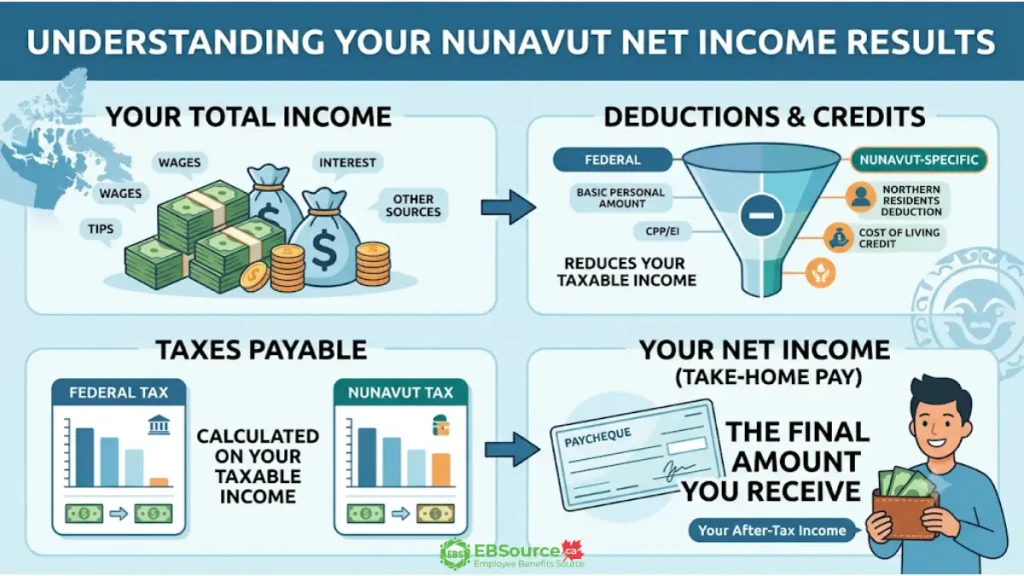
Your Nunavut net income calculator divides your gross pay into four components: gross income, mandatory payroll deductions, income tax, and the net amount that is deposited into your account each pay period. However, the calculator does not currently subtract the separate 2% Nunavut Payroll Tax that may apply to taxable remuneration, so the displayed net income should be treated as an estimate before that payroll tax.
Below are the explanations of four key factors in the Nunavut calculation.
Meaning of the gross income line
Your gross income is the amount before any deductions are applied to your pay. Our calculator determines this amount by multiplying your pay per period by the total number of pay periods in the year. Every other figure displayed on the results screen is based on this amount, so ensure it matches the information on your T4 slip or your offer letter before proceeding to the next steps.
Meaning of the payroll deduction lines
EI and CPP contributions are the first deductions taken from gross pay. For 2026, EI premiums are set at 1.63% of insurable earnings, with a maximum contribution of $1,123.07. Besides, the CPP rate is 5.95% on earnings exceeding the $3,500 basic exemption, up to a cap of $4,230.45.
If your income falls between $74,600 and $85,000, a second-tier CPP2 rate of 4% applies to the amount above $74,600, up to a maximum of $416.
These deductions also generate federal credits that help reduce your tax liability. This is why they are shown separately in the calculator, rather than combined into a single deduction line.
In addition, employees in Nunavut may have to pay a separate 2% Nunavut Payroll Tax on their taxable earnings, which differs from federal or territorial income tax, as well as from the CPP and EI. Since our calculator does not include this tax, you should calculate this amount separately when comparing the calculator results with your pay stub.
Meaning of the federal and Nunavut tax lines
Federal taxes for 2026 are based on brackets ranging from 14% to 33%, depending on your income. According to the CRA, the federal tax rates are:
- 14% on income up to $58,523
- 20.5% on income from over $58,523 to $117,045
- 26% on income from over $117,045 to $181,440
- 29% on income from over $181,440 to $258,482
- 33% on income over $258,482
You can also reduce your tax owing with credits such as the federal basic personal amount of up to $16,452 for those with a net income up to $181,440 (it gradually decreases to $14,829 for incomes above $258,482), as well as CPP and EI contributions.
In addition, Nunavut offers its own tax credits based on a basic personal amount of $19,659 for 2026, which is one of the highest in the country. Moreover, its separate tax brackets are among the lowest in Canada. For this tax year, the tax rates in Nunavut are:
- 4% on income up to $55,801
- 7% on income from over $55,801 to $111,602
- 9% on income from over $111,602 to $181,439
- 11.5% on income above $181,439
Meaning of the net income line
Your net annual income is calculated by subtracting all deductions from your gross income, then dividing the result by the number of pay periods to determine your take-home pay.
Nunavut-specific note: Payroll deductions do not include the Northern Residents Deduction during the year unless you have set up reduced deductions with the CRA. This means our calculator might show a lower amount than your final tax return if you claim northern deductions later.
Source: Payroll Deductions Tables – CPP, EI, and income tax deductions – Nunavut – Government of Canada
What is your combined marginal tax rate in Nunavut?
Your combined marginal tax rate in Nunavut, which ranges from 18% to 44.5%, is the percentage of tax you pay on each additional dollar you earn, including both federal and Nunavut rates. The higher your marginal rate, the more each dollar of deduction saves you.
Understanding this rate is important because it shows how much of a raise, bonus, or extra shift you actually keep. In addition, it’s the figure that determines the actual value of deductions such as the Northern Residents Deduction.
The table below shows the combined federal-and-territorial marginal rate that applies across each income band in 2026:
| Taxable income | Combined marginal tax rate | Federal tax rate | Nunavut tax rate |
|---|---|---|---|
| Up to $55,801 | 18% | 14% | 4% |
| $55,801 to $58,523 | 21% | 14% | 7% |
| $58,523 to $111,602 | 27.5% | 20.5% | 7% |
| $111,602 to $117,045 | 29.5% | 20.5% | 9% |
| $117,045 to $181,439 | 35% | 26% | 9% |
| $181,439 to $258,482 | 40.5% | 29% | 11.5% |
| Over $258,482 | 44.5% | 33% | 11.5% |
Note that only the portion of income that falls within each tax band is taxed at that band’s rate, meaning your overall effective tax rate is lower than your highest marginal rate. For example, someone earning $90,000 pays 18% on the first $55,801 and only pays higher rates on income above that threshold, resulting in an effective tax rate lower than the 27.5% rate they may reach.
Additionally, the Northern Residents Deduction is more beneficial for higher-income residents in Nunavut. For example, a person in the 18% tax bracket saves about $1,445 from the $8,030 residency deduction, while someone in a higher tax bracket benefits even more because deductions apply to their higher income first.
What makes Nunavut’s tax situation unique in Canada?
Nunavut stands apart because it combines the lowest tax rates in the country with special northern benefits that southern provinces lack. Three features create this advantage: one of the highest basic personal amounts in Canada, which protects more of your income before taxes are applied; the lowest set of territorial tax rates, ranging from 4% to 11.5%; and extra northern support programs added on top of those low rates. Together, they mean the same salary often gives you more money to keep in Nunavut than almost anywhere else in the country.
Here’s a closer look at how each of these factors works and what it means for your bottom line:
One of the highest basic personal amounts in Canada
Nunavut’s basic personal amount for 2026 is $19,659, which means you do not pay territorial tax on the first portion of your income up to that amount. When you combine this with the federal basic personal amount of up to $16,452, a large portion of your income is shielded before any tax applies. For people with lower incomes, this high limit can lower or even remove the territorial tax they owe.
The lowest set of tax brackets among the provinces and territories
Nunavut has low territorial tax rates, starting at 4% and rising to a top rate of 11.5%, which are lower than those in many other provinces in Canada. Because the total income tax blends these low rates with federal rates, residents usually pay less overall tax than those in higher-tax provinces. This results in better take-home pay for employees in Nunavut with the same gross salary. However, actual take-home pay also depends on CPP, EI, the separate 2% Nunavut Payroll Tax, employer-specific deductions, and local living costs.
Northern relief stacks on top of low rates
What truly distinguishes Nunavut is that its low rates are layered with targeted northern support. Programs such as the Cost of Living Tax Credit, the Northern Residents Deduction, and the Canada Groceries and Essentials Benefit provide different types of assistance. To discover more about these benefits, read the section below.
What are the specific benefits in Nunavut that affect the outcome?
Due to the remote location and harsh weather conditions, the costs of housing, food, and transportation in Nunavut are higher than in southern Canada. To help offset these challenges, both the territorial and federal governments offer targeted tax relief.
In 2026, residents of Nunavut can reduce their income taxes by taking advantage of the Cost of Living Tax Credit, the Northern Residents Deduction, and the Canada Groceries and Essentials Benefit.
Here’s a detailed explanation of each benefit:
Nunavut Cost of Living Tax Credit
The Nunavut Cost of Living Tax Credit is a refundable credit for anyone who was a resident of Nunavut at the end of the year. Because it is refundable, you can receive it even if you owe no territorial tax.
The resident may claim a maximum of $1,500 as a refundable tax credit. If you are a single parent with an adjusted net income over $60,000, you can claim a cost-of-living supplement of 2% on the amount above that, up to $300. (For this credit, a single parent is someone who is unmarried or in a separated common-law partnership and has custody of a child under 18 at least half the time.)
To claim the credit, complete Form NU479 Nunavut Credits and attach it to your tax return. Your territorial tax itself is calculated on Form NU428 Nunavut Tax.
Northern Residents Deduction
The Northern Residents Deduction is a federal deduction that decreases your taxable income before tax rates are applied. It consists of two parts: a residency deduction and a travel deduction. The actual savings depend on your tax bracket, making it more beneficial for middle- and higher-income earners.
Every community in Nunavut is classified within Zone A (the prescribed northern zone), which qualifies for the full deduction amounts. To be eligible, you must have lived in a prescribed zone permanently for at least 6 consecutive months.
Here is how each part of the Northern Residents Deduction is calculated and what you can expect to claim:
Residency Component
The basic residency amount is $11 per day in Zone A. If you are the only person in your household claiming this basic amount, you can also claim an additional $11 per day, bringing the total deduction to $22 per day. Over the course of a full calendar year, a sole claimant can deduct approximately $8,030.
This is where households need to be careful. Each person living in the home can claim the $11-per-day basic amount. But the extra $11 per day can only be claimed by one person if they are the only one in the household claiming the basic amount.
So, a couple cannot each deduct the full $8,030. They have two choices: each spouse can claim just the basic amount, about $4,015 each for a full year, or one spouse can claim both the basic and extra amounts (about $8,030) while the other spouse claims nothing for living there.
Travel Component
The travel component allows you to claim a deduction for up to two personal trips and an unlimited number of medical trips taken during the year. The amount you can claim for each trip is the lowest of the following three options:
- The taxable travel benefit you received from your employer for that trip (found in Box 32 of your T4 slip), or the $1,200 standard amount per person if you did not receive an employer travel benefit.
- The total travel expenses you incurred for the trip, including airfare, meals, and hotels.
- The cost of the lowest return airfare available at the time of the trip between the airport closest to your home and the “closest designated city” (which is usually Edmonton, Winnipeg, Ottawa, or Montreal for Nunavut residents).
To make a claim, use Form T2222 Northern Residents Deductions and submit it along with your tax return. For those who do not receive employer benefits, the “Standard Rate” of $1,200 per person per trip (up to two trips) can serve as a reference for the second condition, but you still need to meet the LRA requirement.
One thing to watch in 2026 is that the CRA highlighted the need to separate transportation and lodging costs when submitting vacation packages. Bundling them together could get your claim rejected during an audit.
How the Travel Component Benefits Employees in Nunavut
To see how this deduction translates into real savings, remember that the benefit scales with your marginal rate:
- A resident in the combined 29% federal-and-territorial bracket who claims the full $8,030 residency deduction saves about $2,329.
- A lower-income resident taxed at the combined 18% rate (14% federal plus 4% Nunavut) saves closer to $1,445 on the same deduction.
Even in a low-income year, filing a return is worthwhile. This deduction may reduce your taxable income below the basic personal amount, which could eliminate your tax obligation.
Canada Groceries and Essentials Benefit
Starting in July 2026, the federal government introduces the Canada Groceries and Essentials Benefit to replace the GST/HST credit. This program is especially important for families in Nunavut, where many still struggle to get enough food. It provides a one-time extra payment on June 5, 2026, and increases the regular payments by 25% every 3 months for 5 years (2026-2031), effective July 2026.
The table below shows the benefit amounts by type, alongside the updated GST/HST credit maximums:
| Component | Single individual | Family of four |
|---|---|---|
| Current GST/HST credit annual maximum, to June 2026 | $533 | $698 + $184 per child |
| One-time top-up, June 5, 2026 | Income-dependent, approximately 50% of your credit | Income-dependent, approximately 50% of your credit |
| Enhanced quarterly amount annual maximum, from July 2026 | $679 | $890 + $234 per child |
The one-time June top-up is based on your income rather than a flat amount. For example, the CRA notes that a single person with $25,000 in net income receives a one-time top-up of about $267, while a family of four with $40,000 in net income receives about $533. Including both the top-up and the enhanced quarterly payments, a single person can receive up to $950 in 2026, and a family of four can receive up to $1,890.
How Nunavut Benefits Add Up in Real-Life Scenarios
Knowing these factors separately only gives part of the picture, as many residents qualify for multiple benefits at once. The following three examples show how the Cost of Living Tax Credit, Northern Residents Deduction, and Canada Groceries and Essentials Benefit can affect different households: a single worker with a modest income, a single parent with a middle income, and a dual-income family of four.
Note that they assume each household lived in Nunavut all year, qualified for the Zone A residency amount, earned only work income, and had no RRSP deductions, pension changes, union fees, childcare expenses, or other major credits.
The table below gives you a quick comparison before the detailed breakdowns that follow, assuming each household spent the entire year in Nunavut and met the six-month residency requirement.
| Household | Key benefits combined | Total relief |
|---|---|---|
| Single worker earning $45,000 | Cost of Living Credit, full residency deduction, and grocery benefit | About $3,295 |
| Single parent earning $70,000 | Cost of Living Credit with top-up, full residency deduction, grocery benefit | About $4,400 |
| Family of four earning $120,000 | Two Cost of Living Credits, two residency deductions, family grocery benefit | More than $8,000 |
Here’s a closer look at how these benefits apply to three typical households, assuming they each spent the entire year in Nunavut and met the six-month residency requirement.
Example 1: A single worker earning $45,000
Start with the Cost of Living Tax Credit, which is 2% of adjusted net income, resulting in about $900 for this worker. Next, the Northern Residents Deduction reduces the income on which they pay tax: claiming the full $8,030 residency amount at an 18% tax rate saves about $1,445.
Finally, with income at this level, the Canada Groceries and Essentials Benefit provides a one-time extra payment and larger quarterly payments, potentially totalling $950 over the year. Together, these three help put nearly $3,295 back in this worker’s pocket, before considering the basic personal amounts that already protect the first $19,659 of territorial income.
Example 2: A single parent earning $70,000
This single parent qualifies for the basic Cost of Living Tax Credit of 2%, with a maximum limit of $1,500. Because their adjusted net income exceeds $60,000, they also receive an extra 2% credit on the income above that amount, adding about $200 toward a separate limit of $300.
The Northern Residents Deduction is especially helpful at this income level because the $8,030 residency amount reduces the income subject to the 27.5% tax, resulting in about $2,208 in taxes.
Also, higher Canada Groceries and Essentials Benefit payments for a family help this household get several thousand dollars in total relief.
Example 3: A family of four earning $120,000
At this income level, a couple can receive up to $3,000 in the Cost of Living Tax Credit, or $1,500 each.
The Northern Residents Deduction provides the greatest benefit here, but only one adult can claim the additional residency amount. If one spouse claims the full $22 per day ($8,030), they save about $2,811 in taxes at a combined tax rate of 35%. The other spouse can claim the basic $ 11-per-day rate ($4,015), saving about $1,405.
Also, the family can get the improved Canada Groceries and Essentials Benefit, which can give up to $1,890 for a family of four in 2026. Overall, these northern benefits could lower the household’s taxes by more than $8,000 and provide extra direct payments.
FAQs about the Nunavut income tax calculator
What tax form do Nunavut residents need to file with their annual income tax return?
Residents should use Form NU428 to calculate their territorial taxes and credits for their tax return. Complete this form after finishing steps 1 to 5 of your federal income tax return. If you were a resident of Nunavut at the end of the year, you need to fill out Form NU428. The rules for most Nunavut non-refundable tax credits are similar to those in the federal system, but the amounts and calculations may differ.
How does Nunavut’s income tax position compare to that of the rest of Canada?
Nunavut has the lowest income tax rates in Canada. Its income tax system is fair and competitive compared to other provinces and territories. When calculating your income tax in Nunavut, it combines both federal and territorial rates, usually resulting in a lower tax burden than in higher-tax provinces like Ontario, Quebec, or British Columbia for the same income.
Are Inuit residents of Nunavut exempt from income tax?
This is a common misconception. The income tax exemption under Section 87 of the Indian Act applies only to registered “Indians” as defined by that Act, and Inuit are not covered by it. As a result, Inuit residents of Nunavut pay federal and territorial income tax under the same rules as everyone else in the territory. The good news is that they have full access to Nunavut-specific relief, the Cost of Living Tax Credit, the Northern Residents Deduction, and the Canada Groceries and Essentials Benefit, which together can substantially reduce the final amount owed.
Can a Nunavut payroll calculator include the Northern Residents Deduction?
Usually not automatically. Payroll calculators estimate tax deductions from your pay, Canada Pension Plan, Employment Insurance, and tax rates. The Northern Residents Deduction is usually claimed on your yearly tax return using Form T2222, unless you have set up lower payroll tax deductions with the CRA.
Do all Nunavut communities qualify for the full northern deduction?
Yes. Every Nunavut community is in the official northern zone (Zone A), allowing residents to claim the full Zone A residency amount. Residents still have to live there for six consecutive months and keep the required documents to prove their claim.
Can two people in the same Nunavut household both claim the additional residency amount?
No. The extra residency amount can only be claimed if someone in the home claims the basic residency amount for that period. Each person can claim the basic amount, but only one person per home can claim the extra amount, so couples should agree on who claims it before filing.
Disclaimer: Our Nunavut income tax calculator gives general information and estimates payroll deductions based on your employment income. It is not a replacement for CRA payroll tools and does not provide a full personal income tax calculation.
