


As of July 2, 2026, this PEI calculator uses CRA payroll deduction tables alongside the latest federal-provincial tax figures from July 2026.
To find out how much you really earn in Prince Edward Island, you need to consider what remains from your gross earnings after subtracting federal and provincial income taxes, as well as mandatory contributions to the CPP and EI.
Our PEI income tax calculator simplifies this by first annualizing your employment income for each pay period, then subtracting CPP and EI contributions and calculating federal and provincial income taxes on your adjusted income. In 2026, PEI residents pay provincial income tax rates of 9.50% to 20%, plus federal rates of 14% to 33%. This means your total tax rate can be anywhere from 23.50% to 53%.
To manage your final results effectively, it’s also important to understand your expenses and consider strategies like maximizing your retirement savings, claiming the Island Essentials Benefit, and optimizing spousal transfers.
The guide details each step of this calculation and provides the most effective methods for reducing your income tax in PEI for 2026.
How does the Prince Edward Island income tax calculator work?
The calculator converts your gross income into net pay by sequentially deducting mandatory federal programs and income tax. It first applies CPP and EI deductions. Then, it calculates the federal and provincial PEI tax brackets to provide you with an estimate of your take-home pay.
The first type of deduction comes from required federal programs. EI premiums are 1.63% of your earnings, with a yearly cap of $1,123.07 on $68,900 of maximum insurable earnings. CPP contributions are 5.95% on earnings over $3,500, up to the $74,600 maximum pensionable earnings, with a maximum of $4,230.45 per year.
If you earn above $74,600, you also pay a second-tier CPP2 contribution of 4% on earnings between $74,600 and the 2026 second ceiling of $85,000, for a maximum CPP2 amount of $416. That brings the combined CPP and CPP2 maximum to $4,646.45 for 2026.
To calculate your taxable income, start with your base salary and add any additional income, like vacation pay and bonuses. Then, subtract eligible deductions, including RRSP contributions, to get your adjusted taxable income. This will be used to figure out federal and provincial taxes.
Your T4 slip from your employer lists the deductions withheld, which you can compare against our calculator output.
Note: This payroll adjustment is used because employers withheld tax for the first six months of 2026 without the new PEI top bracket. The higher 21% payroll withholding rate for July to December helps offset the difference, making high-income employees less likely to owe a large balance when filing their 2026 return.
Example: How a $ 115K gross salary translates to net salary in PEI
To see how this works in practice, consider someone employed in Prince Edward Island who earns $9,500 per month ($114,000 annually) and receives a $1,000 bonus during the year. Their total employment income comes to $115,000 (= $9,500 × 12 + $1,000 bonus).
Here is how that gross figure becomes take-home pay:
Step 1: CPP and EI contributions
Since this income exceeds the maximums for CPP and EI, both contributions are capped at their 2026 ceilings:
- CPP base: $4,230.45 (the annual maximum)
- CPP2: $416 (earnings fall within the $74,600 to $85,000 band)
- Total CPP: $4,646.45
- EI premium: $1,123.07 (the yearly ceiling)
Step 2: Taxable income
With no RRSP contributions or other deductions entered, the taxable income is:
$115,000 − $711 first additional CPP − $416 CPP2 = $113,873
Step 3: Federal and provincial income tax
The taxable income is taxed across both bracket systems, then reduced by non-refundable credits (the basic personal amount, plus the CPP and EI amounts):
| Layer | Approximate Tax |
|---|---|
| Federal tax | about $16,377 |
| PEI provincial tax | about $13,701 |
| Combined income tax | about $30,078 |
Step 4: Net income
After income tax, CPP, and EI, this earner keeps roughly $78,900 of their $115,000 gross:
| Component | Amount |
|---|---|
| Gross Income | $115,000 |
| Income Tax (Federal + Provincial) | -$30,400 |
| CPP Contributions | -$4,646 |
| EI Premiums | -$1,123 |
| Net Income | $115,000 − $30,077.60 − $4,646.45 − $1,123.07 = $79,152.88 |
That works out to an effective deduction of just over 31%, meaning this earner takes home about 68.8 cents of every gross dollar.
What are PEI Income Tax Brackets and Rates?
As a resident of Prince Edward Island, you pay income tax on two separate levels: federal and provincial income taxes. Both use a progressive tax system, which means your income is divided into brackets, each taxed at a different rate. Only the portion of your income that reaches a higher bracket is taxed at that higher rate.
For the 2026 annual tax return, PEI’s provincial rates span six brackets, ranging from 9.50% to 20%. For payroll withholding from July to December 2026, the CRA applies a prorated 21% withholding rate to taxable income over $200,000 to account for the new top bracket introduced during the year. In addition, the federal personal income tax rate ranges from 14% to 33%.
However, keep in mind that before any taxes are taken out, both governments let you earn a certain amount without paying tax. For 2026, the basic personal amount in PEI is $15,000, up from $14,650 in 2025. At the federal level, the basic personal amount for 2026 is $16,452 for most incomes, gradually decreasing to $14,829 for the highest earners.
Here are the updated federal and provincial income tax brackets and rates in PEI for 2026:
Federal Income Tax Brackets and Rates
The federal income thresholds, personal amounts, and the Canada Employment Amount have been updated based on changes in the Consumer Price Index, with a 2.0% increase starting January 1, 2026. An important change this year is that the 14% lowest federal personal income tax rate now applies for the full year for the first time.
Below are the five federal tax brackets and their corresponding rates for 2026.
| 2026 Federal Taxable Income | 2026 Federal Tax Rate |
|---|---|
| Up to $58,523 | 14% |
| Over $58,523 to $117,045 | 20.5% |
| Over $117,045 to $181,440 | 26% |
| Over $181,440 to $258,482 | 29% |
| Over $258,482 | 33% |
PEI Provincial Income Tax Brackets and Rates
In addition to federal tax, residents of Prince Edward Island are subject to provincial income tax set by the PEI provincial government. In 2026, Prince Edward Island uses a six-bracket tax system. This builds on the 2024 reform that expanded the province’s structure from three brackets plus a surtax to a more transparent bracket system. For 2026, the bracket thresholds were also increased by 1.8% over 2025 so that Islanders can earn more before moving into a higher bracket.
The table below outlines the provincial tax brackets and rates for PEI in 2026:
| 2026 PEI Taxable Income | 2026 PEI Tax Rate |
|---|---|
| Up to $33,928 | 9.50% |
| Over $33,928 to $65,820 | 13.47% |
| Over $65,820 to $106,890 | 16.60% |
| Over $106,890 to $142,520 | 17.62% |
| Over $142,520 to $200,000 | 19% |
| Over $200,000 | 20% |
Please note that the 20% rate mentioned above is the annual rate you will use when filing your tax return. For payroll deductions in the second half of 2026, the CRA will apply a partial 21% rate to any income over $200,000. This change is made to offset the lower offset applied during six months of the year.
Combined Federal and PEI Income Tax Brackets and Rates
Keep in mind that the real amount you pay on each dollar of income is the total of both the federal and provincial tax rates for that income level. Because the federal and PEI tax brackets do not match up at the same income levels, your combined tax rate goes up at more points than either table by itself might show. These in-between steps matter most because this is where pay raises, bonuses, and RRSP deductions have the biggest effect.
Here are the combined 2026 federal and PEI tax brackets:
| 2026 Taxable Income | Federal Rate | PEI Annual Tax-Return Rate | Combined Marginal Rate |
|---|---|---|---|
| Up to $18,684 | 14% | 0% | About 14% |
| $18,684 to $23,000 | 14% | 9.50% | 23.50% |
| Over $23,000 to $30,000 | 14% | 14.50% including PEI low-income reduction clawback | 28.50% |
| Over $30,000 to $33,928 | 14% | 9.50% | 23.50% |
| Over $33,928 to $58,523 | 14% | 13.47% | 27.47% |
| Over $58,523 to $65,820 | 20.5% | 13.47% | 33.97% |
| Over $65,820 to $106,890 | 20.5% | 16.60% | 37.10% |
| Over $106,890 to $117,045 | 20.5% | 17.62% | 38.12% |
| Over $117,045 to $142,520 | 26% | 17.62% | 43.62% |
| Over $142,520 to $181,440 | 26% | 19% | 45% |
| Over $181,440 to $200,000 | 29% | 19% | About 48.30% |
| Over $200,000 to $258,482 | 29% | 20% | About 49.30% |
| Over $258,482 | 33% | 20% | 53% |
From the combined marginal tax rates outlined above, four key patterns emerge that can impact real financial decisions:
- Top Marginal Rate: Once your taxable income exceeds $258,482, every additional dollar you earn is taxed at 53%. This is also the rate at which putting money into an RRSP or other deductions saves you the most on taxes.
- Significant Jump in Rates: Moving into the third federal bracket raises your total tax rate from 38.12% to 43.62%, which is a 5.5-point jump. Salary earned just above $117,045 is taxed at a much higher rate than money just below it. This is why delaying income or timing bonuses around this limit can help.
- Lower Earners Keep More: Below $33,928, the total marginal tax rate is 23.50%. Also, if your income is low enough, the PEI low-income tax reduction can remove the provincial portion completely, so your actual tax rate is even lower.
- Marginal vs Average Tax Rates: Earning $120,000 does not mean you pay 43.62% on all of it. Only about $3,000 of income above $117,045 is taxed at that rate; the rest is taxed at lower rates for income below that amount. So, your average tax rate on your total income will be much lower than your highest marginal tax rate.
Note: These combined rates apply to regular income, such as salary and interest. Eligible and non-eligible dividends, and capital gains are taxed at different rates because of dividend adjustments, tax credits and how much capital gains are counted. Our PEI income tax calculator focuses on employment income, so use the CRA's tools or a CPA for cases involving dividends or capital gains.
PEI Top Bracket and Payroll Adjustment
PEI announced its new highest tax rate on April 14, 2026, which creates a difference between what you owe on your annual tax return and what your employer deducts from each paycheque from July to December 2026. Use 20% when discussing the final annual 2026 PEI tax return rate. Use 21% prorated only when discussing CRA payroll withholding from the first payroll in July 2026 to the end of 2026.
The table below outlines the PEI updated mid-year payroll withholding from July 2026:
| 2026 PEI Taxable Income | July 2026 Payroll Withholding Rate |
|---|---|
| Up to $33,928 | 9.50% |
| Over $33,928 to $65,820 | 13.47% |
| Over $65,820 to $106,890 | 16.60% |
| Over $106,890 to $142,520 | 17.62% |
| Over $142,520 to $200,000 | 19% |
| Over $200,000 | 21% (prorated) |
The prorated 21% withholding rate on income over $200,000 is a way to catch up, not an extra tax. It spreads out the amount that was not taken out earlier over your remaining paycheques, so you do not owe a big amount when you file your taxes.
Note: The 21% top rate is a payroll withholding rate, not the usual yearly PEI tax return rate. Because employers used a lower rate in the first half of 2026, the CRA will apply an adjusted 21% rate for the last six months, starting with the first paycheck in July.

For annual 2026 tax-return estimates, our calculator use PEI’s 20% top rate on taxable income over $200,000.
Source 2: Provincial Personal Income Tax – Government of PEI
How to Reduce Income Tax and Improve After-Tax Income in PEI
There are seven practical strategies worth exploring to reduce income taxes in PEI. These include contributing to an RRSP, incorporating as a consultant, negotiating your salary, deducting moving expenses when relocating for work, optimizing spousal credit transfers, reviewing your TD1 forms annually, and claiming the Island Essentials Benefit.
Here are the explanations of detailed tips:
Contribute to an RRSP
In Prince Edward Island, the second tax bracket begins at $33,928 with a tax rate of 13.47%. Contributing to a Registered Retirement Savings Plan can help you lower your taxable income, potentially leading to a tax refund based on your highest tax rate.
Look at the table below to see how tax is saved in PEI when contributing to an RRSP:
| Taxable income before RRSP | RRSP contribution | Approximate marginal tax rate | Approximate tax savings |
|---|---|---|---|
| $60,000 | $5,000 | 33.97% | about $1,469 |
| $90,000 | $5,000 | 37.10% | about $1,855 |
| $125,000 | $5,000 | 43.62% | about $2,181 |
| $190,000 | $5,000 | 48% | about $2,415 |
The table shows that a higher tax rate means you get more tax savings right away from an RRSP contribution. But remember, money withdrawn from an RRSP is usually taxed later. So, when planning your RRSP, you should also think about how much money you expect to earn in retirement.
Incorporate as a consultant
Incorporating your business can help you pay less income tax because the small business tax rate in PEI is lower than the personal income tax rate. Starting July 1, 2025, PEI’s small-business tax rate is 1%, and the income limit for this rate has increased to $600,000. The general provincial corporate tax rate has also gone down from 16% to 15%. Keep in mind that the federal small business deduction limit is still $500,000.
This means you can keep more money in your business to reinvest and delay paying personal taxes until you take a salary or dividend. But incorporating also means higher paperwork and accounting costs, so it works best for people who earn more than they need for their personal expenses.
Negotiate your salary
As announced by the Government of Prince Edward Island, the minimum wage in PEI is currently $17 per hour (the highest in Atlantic Canada). Starting October 1, 2026, it will increase to $17.30 per hour and to $17.60 per hour on April 1, 2027.
Therefore, when starting a new job or asking for a raise, negotiate your salary based on the after-tax amount so your net pay in PEI matches your needs. For hourly and seasonal workers especially, it helps to translate any raise into an after-tax monthly figure, since that is what actually lands in your budget.
This example below will illustrate the advantage when negotiating your pay to enhance your after-tax income:
| Hourly raise | Annual gross increase at 37.5 hours per week | After-tax value at 27.47% marginal rate |
|---|---|---|
| $0.50/hour | $975 | $707 |
| $1/hour | $1,950 | $1,414 |
| $2/hour | $3,900 | $2,829 |
Deduct moving expenses when relocating for work
If you move for work or to run a business, you might be able to deduct some moving costs. Usually, your new home has to be at least 40 kilometres closer to your new job or business. Qualifying expenses can include moving and storing your household items, travel costs, temporary housing, lease cancellation fees, and some costs related to selling your old home.
Remember that the deduction usually cannot be more than the income you make at your new job, but any leftover amount can be used later.
For example, if someone is moving from Halifax to Charlottetown for a new job, they will likely pass the 40 km test because the move will make their commute much shorter. But if someone is moving within the Charlottetown area, they might not pass this test even if the move is for a job.
Optimize spousal credit transfers
Residents of Prince Edward Island file their taxes individually. Although you can not file jointly, some tax credits can be shared between spouses or common-law partners to lower the total taxes a household pays. These include amounts for a spouse or partner, age, pension income, disability, and tuition. Also, pension income can be split between partners.
For example, if one spouse earns less and has unused age or pension income credits, giving these to the higher-earning spouse can reduce the family’s total tax bill.
Review your TD1 Forms annually
Your employer uses TD1 forms to figure out how much tax to withhold from your paycheque. If you have significant deductions or major credits not included on the basic form, submit a new TD1 to reduce the tax withheld and increase your net pay, rather than waiting for a tax refund.
Claim the Island Essentials Benefit (replacing the Sales Tax Credit)
The PEI Sales Tax Credit is being replaced by this new benefit this year. The Island Essentials Benefit, designed to help with everyday expenses like groceries, gas, and utilities, starts in July 2026 and raises yearly amounts to up to $310 for single Islanders and $365 for couples.
Households earning up to $95,000 receive the full benefit, paid every three months, while those earning up to $114,000 receive at least $175. The CRA runs the program, so you do not have to share private information to get the Island Essentials or Child benefits; you just need to file your income taxes with the CRA.
For example, a single resident of PEI who earns $70,000 may get the full Island Essentials Benefit; however, this amount will not appear in payroll net pay calculations because it is paid separately through CRA benefit payments.
Understand the Island Essentials Benefit: The Island Essentials Benefit is separate from payroll deductions and should not be treated as part of regular paycheque net pay. If eligible, it may improve annual after-tax cash flow, but it will generally be paid separately through the benefit system rather than through your employer.
Note: This is not a paycheque deduction, but it may increase your annual after-tax cash flow. Our PEI income tax calculator estimates payroll deductions only and does not include separate provincial benefit measures.
Source: Provincial Personal Income Tax – Government of PEI
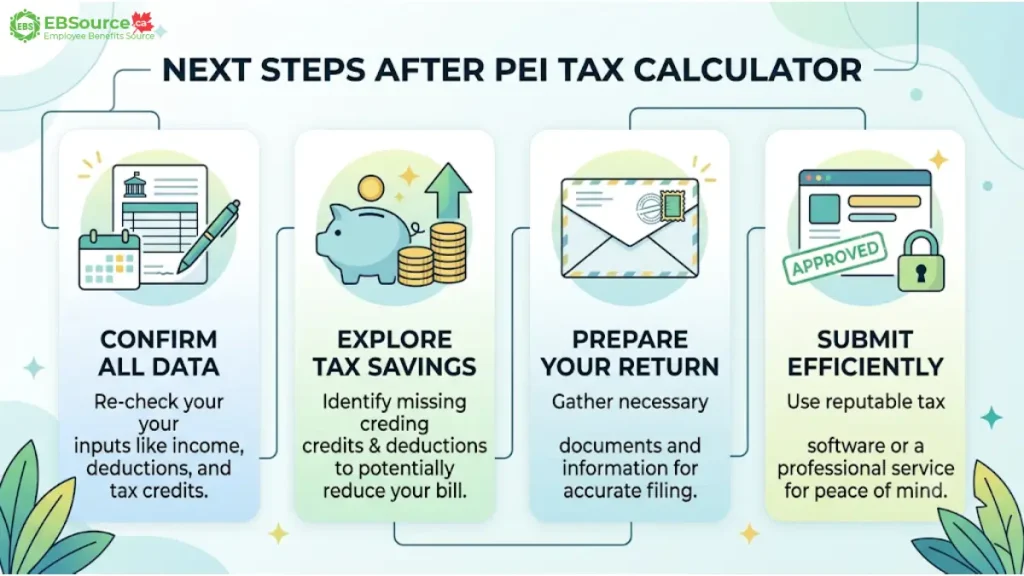
What to do after using our PEI tax calculator
Our calculator result is a starting point, not the final answer. It gives a rough idea of where you stand now, but the real benefit comes from what you do next, such as changing your withholding, claiming benefits, or preparing for a life change.
This quick-reference table helps you find your situation:
| Your result | Recommended action |
|---|---|
| Net pay seems too low | Check pay frequency, TD1 claims, CPP/EI, and any taxable benefits. |
| Tax withheld seems too high | Review your federal TD1 and TD1PE with your employer. |
| You expect credits not to be shown | Track them for your return, as they will not appear in a payroll estimate. |
| You have two jobs | Avoid double-claiming your personal amount across employers. |
| You moved provinces | Confirm December 31 residency rules before assuming your final tax. |
| You are self-employed | Plan for instalments and CPP differently from employee payroll. |
Here is a detailed explanation of what you should do after estimating your income tax in PEI in six distinct situations:
If your net pay seems too low
If your net pay is lower than expected, first check whether our PEI income tax calculator used the correct pay frequency, as this can affect the numbers.
Also, check whether you have reached the yearly CPP or EI limits, because payments stop once you reach them, which can increase your take-home pay later in the year. Low pay at the start of the year might just be due to higher payments earlier in the year.
Next, check for taxable benefits, such as group life insurance or a company car, which can raise your taxable income without giving you extra cash in your paycheque.
Finally, check your TD1 form and TD1PE form with payroll. If you are only claiming the basic personal amount but qualify for more, you might be having too much tax taken out.
If your tax withholding seems too high
The main reason for too much tax being withheld from your paycheque is an outdated TD1 form. If you have deductions or credits not shown on the basic form, such as significant RRSP contributions, the age amount, tuition transfers from a spouse or child, or support payments, you can file a new federal TD1 and a provincial TD1PE to reduce the tax withheld from each paycheque.
For larger or recurring deductions, you can also request a letter of authority (Form T1213) from the CRA. The advantage of this approach is clear: instead of lending the government money interest-free all year and waiting for a refund, you can keep that cash in each paycheque where it can work for you.
Do not reduce withholding too aggressively. If too little tax is deducted during the year, you may owe a balance when filing your 2026 return.
If you expect credits that do not appear in the estimate
Remember that a payroll calculator shows only the amounts taken from your pay, not the amounts on your final tax return. So, refundable credits and benefits will not appear there. Benefits like the Island Essentials Benefit, the PEI Child Benefit, the Children’s Wellness Tax Credit, and the GST/HST credit are adjusted when you file your tax return or paid separately through CRA benefit payments.
To handle this well, set up a folder, either paper or digital, to save receipts for wellness activities, medical costs, charitable donations, and child-care expenses.
If you have two jobs
Be aware of double-claiming taxes when you have more than one job. Employers may assume each job is your only income source. If you claim the full BPA on both job forms, you might end up paying too little tax and could owe money when filing. To avoid this, claim the personal amount on the form for your higher-paying job and mark the “more than one employer” box on the other form to ensure the right tax rate is applied.
Also, remember that contributions to CPP and EI are deducted separately by each employer, which can result in overpayment. Fortunately, any excess CPP or EI contributions will be refunded or credited when you file your taxes, so you will not lose that money.
Example: If you earn $42,000 from your main job and $16,000 from a second job, you might not have enough tax taken out. This happens because each employer looks only at their own job when figuring out taxes, so they each use the full basic personal amount.
To lower the chance of owing taxes when you file, you should claim the basic personal amount on just one TD1 form, usually for the job that pays more. On the TD1 form for your second job, you should say that you have more than one employer.
If you moved provinces during the year
Your employer withholds tax based on your province of employment, but your final provincial tax is usually based on where you are a resident on December 31, 2026. If you moved into or out of PEI during the year, your actual tax bill might be quite different from what was taken out. This is because tax rates, brackets, and credits change from province to province.
Make sure you know which province you will be considered a resident of at the end of the year. If that province’s tax rates are different from what your employer is withholding, save the extra money or change your withholding to avoid a surprise when you file your taxes.
If you are self-employed
If you work for yourself, payroll deductions do not apply to you, so your taxes work differently. Instead of taxes being taken from each paycheque, you usually make four payments a year. You also have to pay both parts of the CPP contributions on your business income.
To manage it, estimate your yearly tax and CPP payments, divide that amount by your payment dates, and keep the money in a separate account. Remember to keep track of your business expenses. If you earn enough, consider talking to a CPA about forming a corporation, since the small-business tax rate in PEI is lower than the personal tax rate, which might save you money.
FAQs about the Prince Edward Island income tax calculator
What is the PEI Low-Income Tax Reduction threshold?
As of December 31, 2026, residents of Prince Edward Island earning up to $18,684 will not have to pay provincial income tax due to a low-income tax reduction. For incomes above $23,000, this reduction is gradually phased out, adding a 5% tax on earnings between $23,001 and $30,000. The low-income tax reduction threshold increased from $22,250 to $22,650 in 2025 and then to $23,000 in 2026.
Can I use this PEI income tax calculator if I am paid hourly or have irregular hours?
Yes. You can use the calculator to get an annual overview of your taxes by entering your expected yearly income or an average pay period amount. However, keep in mind that actual deductions on your paychecks may vary since tax withholding is adjusted each pay period. It is more reliable to use the annual estimate for planning purposes.
What’s the difference between my marginal rate and my average rate in PEI?
Your marginal tax rate is the percentage taken from the next dollar you earn that is taxable. This rate helps you figure out how a raise, bonus, RRSP deduction, or extra work will affect your taxes.
On the other hand, your average tax rate is calculated by dividing your total tax by your total income. This rate is usually lower than your marginal tax rate because the first parts of your income are taxed at lower rates.
For example, a person earning just over $117,045 will pay 43.62% tax on the next dollar they earn in 2026. But their overall tax rate is lower because most of their income is taxed at lower rates.
How does the Island Essentials Benefit affect my PEI take-home income?
The Island Essentials Benefit does not make your paycheque higher or lower your payroll deductions, so it usually does not appear in a PEI income tax calculator. Instead, it is a separate provincial benefit managed by the CRA and paid after you file your tax return.
Why might a PEI employee’s net pay increase later in the year?
A PEI employee’s take-home pay may go up later in the year if they reach the yearly limit for CPP or EI payments. After these deductions are fully paid, your employer usually stops taking them out, which can lead to bigger paycheques for the rest of the year.
This often happens to employees with higher salaries, bonuses, or uneven income. If your take-home pay changes during the year even though your total salary stays the same, it’s a good idea to check the CPP and EI limits first.
Methodology: This calculator estimates taxes based on the 2026 federal and PEI tax rates and the employee CPP, CPP2, and EI contribution limits. It only calculates taxes on employment income and excludes factors such as capital gains, dividends, self-employment CPP, refundable benefits, employer-specific deductions, union fees, pension changes, and taxable benefits unless included separately.
