


This Alberta calculator was updated on July 8, 2026. It is based on CRA deduction rules and reflects the current federal and Alberta rate data as of July 2026.
This Alberta income tax calculator requests your gross pay, pay frequency, and any additional earnings or deductions, then hands back a detailed breakdown of federal tax, provincial tax, CPP contributions, EI contributions, and the net amount that will actually reach your account.
To generate these figures, the calculator follows a four-step process: first, confirming mandatory payroll deductions; second, applying the applicable federal and provincial tax rates along with any relevant credits; third, combining those rates into your marginal tax rate; and fourth, dividing the final amount after deductions by the number of pay periods to calculate your take-home pay per period.
How to Use Our Alberta Income Tax Calculator
To use our Alberta income tax calculator, start by selecting Alberta as your province, then input your earnings, pay period, and any applicable earnings or deductions. If you leave any field blank, the calculator will treat it as zero. Once you have entered all the necessary information, you will receive a breakdown of your federal tax, provincial tax, CPP, EI, and net pay.
Once you receive the output, compare your marginal tax rate to your average tax rate. This comparison will help you understand how additional income or deductions could affect your overall tax bill. Be aware that the accuracy of your estimate depends on how you enter all income sources and deductions that the calculator accepts.
How Our Calculator Determines After-tax Income in Alberta
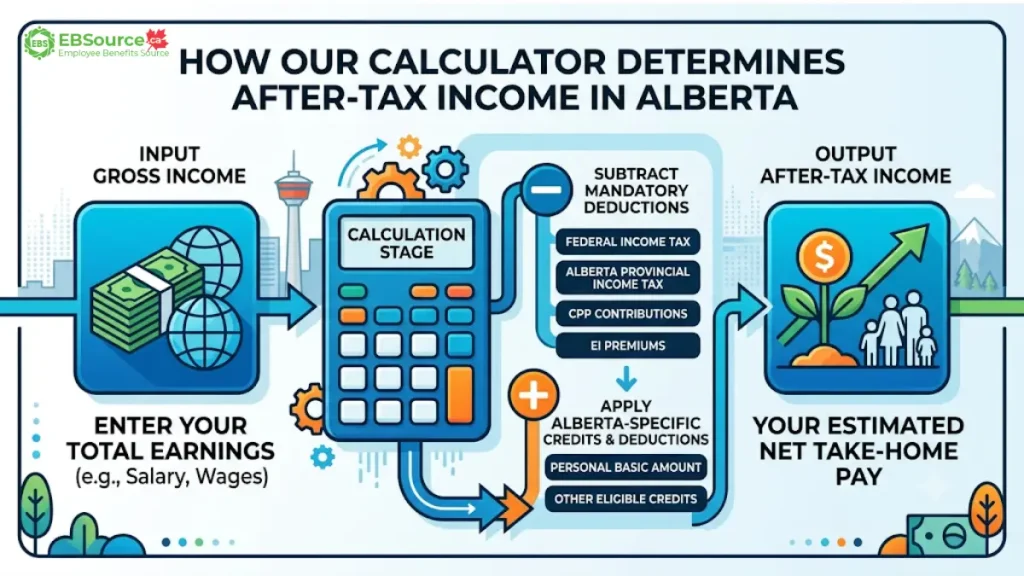
Calculating your net pay in Alberta involves four steps: determining mandatory payroll deductions, calculating income taxes, calculating the combined marginal rate, and finally arriving at your net income, which is divided by your pay periods.
The following will walk you through each step using the most recent federal and Alberta figures:
Step 1: Find the mandatory deductions
The first step to calculating your net salary in Alberta is to multiply your pay by the number of pay periods to get your gross annual income. From this amount, deduct EI premiums at 1.63% of your gross income, up to a maximum of $1,123.07 and CPP contributions at 5.95% on earnings above $3,500, with a maximum of $4,230.45.
If your income exceeds $74,600, a CPP2 rate of 4% will apply to the earnings between $74,600 and $85,000, with a maximum limit of $416. Your taxable income is determined by adding any other sources of annual income, such as vacation pay and bonuses, and then subtracting applicable deductions, including RRSP contributions and the initial additional CPP contribution.
Step 2: Calculate the federal and provincial income tax
Federal income tax is determined based on the 2026 federal tax brackets, which range from 14% (formerly 15%) to 33%. Alberta provincial tax is calculated separately using provincial brackets ranging from 8% to 15%, with credits based on Alberta’s basic personal amount of $22,769.
The following tables illustrate the federal and provincial tax brackets and rates for 2026:
2026 Federal Tax Rates:
| 2026 federal taxable income | Federal tax rate |
|---|---|
| Up to $58,523 | 14% |
| Over $58,523 to $117,045 | 20.5% |
| Over $117,045 to $181,440 | 26% |
| Over $181,440 to $258,482 | 29% |
| Over $258,482 | 33% |
2026 Alberta Tax Rates:
| 2026 Alberta taxable income | Alberta tax rate |
|---|---|
| Up to $61,200 | 8% |
| Over $61,200 to $154,259 | 10% |
| Over $154,259 to $185,111 | 12% |
| Over $185,111 to $246,813 | 13% |
| Over $246,813 to $370,220 | 14% |
| Over $370,220 | 15% |
Note that your tax can be reduced by non-refundable tax credits, which will be explained in the following section. These credits are based on the federal basic personal amount ($16,452 for people with net income of $181,440 or less; this amount gradually decreases to a minimum of $14,829 for those earning over $258,482), CPP base contributions, EI premiums, and the Canada Employment Amount ($1,501).
Step 3: Calculate the Alberta combined marginal income tax
Although the tax brackets for federal and Alberta taxes are shown separately above, your tax on extra income (such as a raise, overtime, or bonus) is based on the combined federal-plus-provincial rate for your income level. This combined marginal tax rate indicates how much of each additional dollar earned will go toward federal and provincial taxes, excluding payroll deductions and credits.
The 2026 Alberta-specific combined marginal tax rates are:
| 2026 Alberta taxable income band | Combined marginal tax rate on regular income |
|---|---|
| Up to $58,523 | 22% |
| Over $58,523 to $61,200 | 28.5% |
| Over $61,200 to $117,045 | 30.5% |
| Over $117,045 to $154,259 | 36% |
| Over $154,259 to $181,440 | 38% |
| Over $181,440 to $185,111 | About 41.29% |
| Over $185,111 to $246,813 | About 42.29% |
| Over $246,813 to $258,482 | About 43.29% |
| Over $258,482 to $370,220 | 47% |
| Over $370,220 | 48% |
Note that the rates labelled as “about” in the range of $181,440 to $258,482 are higher than what you might expect from just adding federal and Alberta tax rates. This is because the federal BPA decreases for income in that range, resulting in an additional effective tax increase of about 0.29%.
Understanding your combined marginal rate is most useful when evaluating financial decisions at the margin, such as taking on overtime, negotiating a raise, or contributing to your RRSP. Look at the example below for a better understanding of how these figures affect your take-home pay.
Example of combined marginal tax rates in Alberta
If you earn $115,000 and get a $5,000 bonus, you will not keep the full amount. You will pay about $1,525 in federal and provincial taxes on that bonus, so you will take home around $3,475 before deductions for CPP and EI.
At higher incomes, taxes increase more noticeably. For example, when earning $170,000 and receiving a $10,000 bonus, you will be taxed at 38%. It results in about $3,800 in taxes, leaving you with roughly $6,200 before CPP and EI deductions.
Step 4: Estimate your net income in Alberta
To figure out your take-home pay, first find your total annual deductions, then subtract them from your gross income. If the total deductions are negative, set them to zero. Divide that amount by the number of paycheques to get your net pay per paycheque.
Source: Payroll Deductions Tables – CPP, EI, and income tax deductions – Alberta – Government of Canada
Step-by-step Calculation Example of Income Tax in Alberta
The two examples below show how the same four-step method works for different pay situations in Alberta for 2026. The first example is a simple salary with no extra earnings, while the second includes vacation pay, a bonus, and other income to show how different earnings affect CPP, EI, and taxes. Both examples assume the person is single, has claim code 1, has no RRSP taken out at the source, and has no taxable benefits.
Example 1: A $60,000 Salary Without Vacation Pay, A Bonus, And Other Income
Here are the details of a worked example for 2026, specific to Alberta, for someone who earns an annual salary of $60,000, paid biweekly (26 pay periods). They do not have an RRSP at source, nor do they receive any taxable benefits. The claim code is 1, which reflects only the basic personal amounts.
Brief guide: An annual salary of $60,000 in Alberta gives you an estimated annual take-home pay of about $47,690.66. The total deductions of $12,309.34 on a gross salary of $60,000 are the sum of:
- Federal Income Tax: Approximately $5,338
- Alberta Provincial Tax: Approximately $2,631
- CPP Contributions: About $3,362
- EI Premiums: About $978
- Estimated monthly income tax calculator for Alberta: $3,974
This table shows each step to figure out the take-home pay from a $60,000 salary for Alberta in 2026:
| Line item | Annual amount | Biweekly amount, 26 pays |
|---|---|---|
| Gross pay | $60,000 | $2,307.69 |
| EI employee contribution | 1.63% × $60,000 = $978, under MIE | $37.62 |
| CPP employee contribution |
Contributory earnings = $60,000 − $3,500 = $56,500. Base CPP, creditable: 4.95% × $56,500 = $2,796.75. First additional CPP, deductible from income: 1.0% × $56,500 = $565. Total CPP withheld = 5.95% × $56,500 = $3,361.75. No CPP2 applies because $60,000 is below the YMPE. | $129.30 |
| Annual taxable income for payroll, CRA line 6 | $60,000 − $565 first additional CPP = $59,435 | — |
| Federal income tax after credits |
Basic federal tax: 20.5% × $59,435 − $3,804 = $8,380.18. Federal credit base: BPA $16,452 + base CPP $2,796.75 + EI $978 + CEA $1,501 = $21,727.75. Federal credits: 14% × $21,727.75 = $3,041.89. Federal tax payable: $8,380.18 − $3,041.89 = $5,338.29. | $205.32 |
| Alberta income tax after credits |
Basic Alberta tax, first bracket: 8% × $59,435 = $4,754.80. Alberta credit base: Alberta BPA $22,769 + base CPP $2,796.75 + EI $978 = $26,543.75. Alberta credits: 8% × $26,543.75 = $2,123.50. Alberta supplemental tax credit: $0, because the credit base is below $61,200. Alberta tax payable: $4,754.80 − $2,123.50 = $2,631.30. | $101.20 |
| Total income tax | $5,338.29 + $2,631.30 = $7,969.59 | $306.52 |
| Estimated net pay | $60,000 − CPP $3,361.75 − EI $978 − tax $7,969.59 = $47,690.66 | $1,834.26 |
The calculation follows the CRA’s T4032 method for 2026: first, the additional CPP amount is deducted from income, then federal and provincial taxes are computed. Non-refundable tax credits are applied at the lowest applicable rates (14% for federal and 8% for Alberta), so they reduce the tax payable, not the taxable income.
Example 2: A $60,000 Gross Income With Vacation Pay, A Bonus, And Other Income
The example above assumes a single, steady salary. However, in real life, many paycheques in Alberta include extra earnings, like vacation pay, year-end bonuses, or money from side jobs. Each of these extra earnings is handled differently for CPP, EI, and tax purposes. Therefore, this example shows how these extras are processed using the same four-step method.
Consider a worker who earns $4,800 each month (with 12 pay periods) and also receives $1,000 in vacation pay, a $400 bonus, and $1,000 in other yearly income, for a total gross income of $60,000.
The salary, vacation pay, and bonus all count toward pension and insurance, which affects the CPP and EI calculations. Other income is added only to taxable income. As in the first example, the claim code remains at 1, with no RRSP deductions taken and no taxable benefits.
| Line item | Annual amount | Monthly amount, 12 pays |
|---|---|---|
| Gross pay | $57,600 salary + $1,000 other income + $1,000 vacation pay + $400 bonus = $60,000 | $5,000 |
| EI employee contribution | 1.63% × $59,000 insurable earnings = $961.70, under MIE | $80.14 |
| CPP employee contribution | Contributory earnings = $59,000 − $3,500 = $55,500. Base CPP, creditable: 4.95% × $55,500 = $2,747.25. First additional CPP, deductible from income: 1.0% × $55,500 = $555. Total CPP withheld = 5.95% × $55,500 = $3,302.25. No CPP2 applies because $59,600 is below the YMPE. | $275.19 |
| Annual taxable income for payroll, CRA line 6 | $60,000 − $555 first additional CPP = $59,445 | — |
| Federal income tax after credits | Basic federal tax: 20.5% × $59,445 − $3,804 = $8,382.23. Federal credit base: BPA $16,452 + base CPP $2,747.25 + EI $961.70 + CEA $1,501 = $21,661.95. Federal credits: 14% × $21,661.95 = $3,032.67. Federal tax payable: $8,382.23 − $3,032.67 = $5,349.55. | $445.80 |
| Alberta income tax after credits | Basic Alberta tax, first bracket: 8% × $59,445 = $4,755.60. Alberta credit base: Alberta BPA $22,769 + base CPP $2,747.25 + EI $961.70 = $26,477.95. Alberta credits: 8% × $26,477.95 = $2,118.24. Alberta supplemental tax credit: $0, because the credit base is below $61,200. Alberta tax payable: $4,755.60 − $2,118.24 = $2,637.36. | $219.78 |
| Total income tax | $5,349.55 + $2,637.36 = $7,986.92 | $665.58 |
| Estimated net pay | $60,000 − CPP $3,302.25 − EI $961.70 − tax $7,986.92 = $47,749.13 | $3,979.09 |
The total income of $60,000 is taxable, but only the $59,000 in employment earnings (salary, vacation pay, and bonus) forms the CPP and EI base. Like Example 1, total credits are under $61,200, so the K5P is $0.
The takeaway is that variable earnings do not receive special tax treatment on your paycheque; they simply increase the base that CPP, EI, and income tax apply to. What changes your actual tax rate is not the type of income, but the tax bracket it falls into, which is why knowing your salary level is more important than the details of each pay component.
Note: Results are estimates and may vary if you hold multiple jobs, have unusual pay cycles, partial-year CPP or EI liability, source-deduction adjustments, or receive non-periodic payments such as bonuses or retroactive pay.
What Changes for the Alberta Income Tax Calculator in 2026?
The Government of Alberta announced a new tax rate of 8% that was applied to the first $60,000 of an individual’s taxable income for the tax year 2025. In 2026, this $60,000 threshold is indexed to $61,200, while the 8% tax rate continues to apply to the new bracket. The same indexation applies to the other income thresholds, so the tax calculator reflects the existing rates in the newly indexed brackets, along with an Alberta basic personal amount of $22,769.
At the federal level, the lowest personal tax rate was reduced from 15% to 14%, effective July 1, 2025. It results in a blended effective rate of 14.5% for 2025 and a full-year rate of 14% for 2026 and later years. Additionally, in 2026, income thresholds and personal amounts have been adjusted for inflation, with a federal indexing factor of 2.0%.
The following table summarizes the changes between 2025 and 2026:
| Item | 2025 | 2026 | Why it matters |
|---|---|---|---|
| Lowest Alberta tax rate | 8% | 8% | The new lower bracket continues |
| First Alberta bracket ceiling | $60,000 | $61,200 | More income is taxed at 8% |
| Alberta basic personal amount | $22,323 | $22,769 | A higher provincial credit reduces tax |
| Start of the highest Alberta tax bracket | $362,961 | $370,220 | High-income thresholds are also indexed |
| Lowest federal tax rate | 14.5%, blended | 14% | 2026 is the first full year at 14% |
| Federal basic personal amount, maximum | $16,129 | $16,452 | A higher federal credit reduces tax |
Because these indexed figures take effect on January 1, 2026, calculators that still use 2024 or 2025 rates produce less accurate estimates for the current year.
What Do These Changes Mean for Alberta Employees?
The 2026 changes may appear to be routine indexation adjustments, but they actually affect how much tax you pay and your take-home pay. The key changes are Alberta keeping its 8% tax bracket and the federal tax rate lowering to 14%, both of which reduce the tax taken from your income.
For example, in 2026, the first $61,200 earned in Alberta will be taxed at 8%, which means a worker can save up to $1,224 in provincial tax before any credits. The federal tax rate also drops to 14% on the first $58,523 of income. A one-percentage-point change in tax rates means about $585 in total tax before credits, not including the lower rate applied to most non-refundable credits. The federal government estimates that the maximum tax relief will be $420 per person in 2026.
With higher BPA ($22,769 provincially and up to $16,452 federally), most full-time workers will take home more money in 2026 than in 2025. However, the lower provincial tax rate reduces the value of Alberta’s non-refundable tax credits, which are calculated based on the lowest tax rate. To fix this, Alberta created the K5P. Overall, most workers benefit from the 2026 changes, but the amount depends on their income and the credits they can use.
Why Your Alberta Paycheque May Differ From Our Calculator
Your employer’s tax withholding may differ from the results of our Alberta income tax calculator. Common causes include your TD1 and TD1AB claim amounts, year-to-date deductions for CPP or EI, taxable benefits such as employer-paid group life insurance, pension or RRSP contributions, union dues, bonus payments, commission income, partial-year employment, holding multiple jobs, or if you work in a different province than where you reside.
As a result, if your pay stub shows a significant difference from the calculator, please check with your payroll department. Confirm your claim code, verify whether taxable benefits are being added to your income, and ensure that no additional tax is being withheld as requested on a prior TD1 form.
Alberta Net Pay Examples by Salary Levels
The $60,000 example above illustrates the step-by-step calculation process. However, your salary may vary, and your tax outcome can vary significantly across income levels due to the progressive tax bracket system, the CPP, additional CPP thresholds, and the EI caps.
The following table presents estimated annual and monthly net pay for nine common salary levels in Alberta (note that all examples assume a single individual with standard claim amounts (Claim Code 1), no RRSP contributions, no taxable benefits, and no special credits).
| Alberta salary | Estimated net pay | Federal tax | Alberta tax | CPP | CPP2 | EI |
|---|---|---|---|---|---|---|
| $45,000 | $36,937 | $3,338 | $1,522 | $2,469 | $0 | $733 |
| $60,000 | $47,691 | $5,338 | $2,631 | $3,362 | $0 | $978 |
| $75,000 | $57,362 | $8,259 | $4,010 | $4,230 | $16 | $1,123 |
| $85,000 | $64,034 | $10,227 | $4,970 | $4,230 | $416 | $1,123 |
| $100,000 | $74,459 | $13,302 | $6,470 | $4,230 | $416 | $1,123 |
| $130,000 | $94,658 | $20,102 | $9,470 | $4,230 | $416 | $1,123 |
| $150,000 | $107,458 | $25,302 | $11,470 | $4,230 | $416 | $1,123 |
| $200,000 | $137,854 | $38,877 | $17,500 | $4,230 | $416 | $1,123 |
| $250,000 | $166,686 | $53,524 | $24,021 | $4,230 | $416 | $1,123 |
The above estimates are based on the maximum amounts for the 2026 CPP, CPP2, and EI, as well as the federal and Alberta tax brackets mentioned earlier on this page. Your actual net pay may vary due to factors such as RRSP contributions, taxable benefits, additional income sources, or credits beyond the basic personal amounts.
What Tax Credits in Alberta Can Help Increase Your Net Income?
Both federal and Alberta non-refundable credits are available to reduce the actual amount of tax you owe after calculating your federal and provincial taxes. This means your employer automatically accounts for basic personal amounts, CPP contributions, and EI premiums in each paycheque.
However, other credits, such as those for tuition, medical expenses, and adoption costs, need to be claimed when you file your tax return. They will not affect your paycheque, but can decrease your tax bill or increase your refund when you file.
The key federal and Alberta credits that can help lower your overall tax burden for 2026 are:
Federal Non-Refundable Tax Credits
The federal government offers non-refundable tax credits that reduce the amount of federal income tax you owe, rather than lowering your taxable income. For 2026, these credits are calculated by multiplying their eligible amounts by a 14% federal tax rate.
The basic personal amount, CPP contributions, EI premiums, and the Canada Employment Amount are automatically included in payroll deductions. Others, such as the tuition tax credit, student loan interest, and adoption expenses, need to be claimed when you file your annual tax return and will affect your final tax balance then. Additionally, the tuition tax credit can be transferred to a family member or carried forward to a future tax year if not used.
Below are 7 key federal non-refundable tax credits that you may be eligible to claim:
- Canada Pension Plan: For 2026, total CPP is 5.95% on earnings above the $3,500 exemption up to the $74,600 YMPE, and CPP2 is 4% on pensionable earnings between $74,600 and $85,000.
- Employment Insurance: You can claim a credit for EI premiums withheld at 1.63% of insurable earnings, up to an annual maximum of $1,123.07.
- Canada Employment Amount: This is a credit on employment income, included in the federal tax brackets, set at $1,501 for 2026.
- Federal Basic Personal Amount: This factor reduces federal tax owed; it is set at $16,452 for 2026 and phases down to $14,829 for net income between $181,440 and $258,482.
- Interest on Student Loans: Claim an interest credit actually paid on eligible government student loans under federal or comparable provincial legislation.
- Tuition Tax Credit: Claim eligible post-secondary tuition fees; any unused credits can be transferred or carried forward.
- Adoption Expense Credit: Offsets eligible adoption costs for a child under 18, up to the maximum amount per child.
Alberta Non-Refundable Tax Credits
Alberta offers various non-refundable tax credits to help lower your provincial tax bill, calculated using the province’s 2026 lowest provincial tax rate of 8%. To offset the impact of this rate reduction, the government introduced the Supplemental Tax Credit (K5P) for residents with total credits exceeding $61,200.
The provincial credit base typically consists of the basic personal amount, base CPP contributions, and EI premiums. Some credits, like the spouse or partner amount and the disability amount, can be transferred between partners, benefiting households with one high-income and one low- or no-income individual.
Here are 7 non-refundable tax credits in Alberta that may reduce your provincial tax for 2026:
- Alberta Basic Personal Amount: It reduces provincial tax payable through a non-refundable tax credit. It does not directly reduce taxable income. For 2026, the AB BPA is indexed at $22,769, the highest among all provinces.
- Spouse or Partner Amount: You may be able to claim a provincial credit for your spouse or common-law partner.
- Age Amount: You can claim this Alberta tax credit if you meet the age criteria.
- Pension Income Credit: Tax credits are available in Alberta for certain pension income.
- Disability Amount: If certified as disabled, this provides tax credits that may be transferred to a spouse or partner.
- Medical Expenses: You can claim tax credits for qualifying medical expenses in excess of a percentage of your net income.
- Alberta Supplemental Tax Credit (K5P): If the total eligible Alberta non-refundable credit amounts exceed $61,200, an additional non-refundable credit applies. The K5P credit is calculated as 2% of the eligible credit amount above $61,200. This preserves the value of certain Alberta credits after the lowest provincial tax rate dropped from 10% to 8%.
If your total non-refundable credits exceed $61,200, you receive an additional credit calculated as: (Total Non-refundable Credits – $61,200) x 2%. The 2% rate equals the gap between the old 10% lowest bracket and the new 8% rate, ensuring you still receive the equivalent of a 10% credit value on the excess.
FAQs about the Alberta income tax calculator
Which Alberta provincial tax credits were eliminated at the end of 2025?
The Alberta Climate Leadership Adjustment Rebate (ACLAR) and the Alberta Family Employment Tax Credit (AFETC) were cancelled in 2019 and 2020, respectively, but residual entitlements continued to be administered to accommodate late-filed returns and reassessments. After December 31, 2025, all remaining entitlements under both programs were officially eliminated.
Neither credit will reduce a resident’s provincial tax for 2026 and subsequent years and should not be included in any income tax calculations for the current year.
What happens if an Alberta worker pays too much in CPP contributions because they have multiple jobs?
If you contributed too much to CPP or earned less than the minimum amount during the year, you will get a refund when you file your taxes. This often happens when someone in Alberta works for multiple employers, each of which deducts CPP contributions. The CRA checks your total contributions when you file your T1 return, and any extra payments will either be refunded or reduce your taxes owed.
