


Ontario workers who want to understand what makes Ontario different from most other provinces can use our Ontario income tax calculator. The key reason is that it has additional charges on top of the usual federal tax rates, such as provincial taxes, surtaxes, and the Ontario Health Premium.
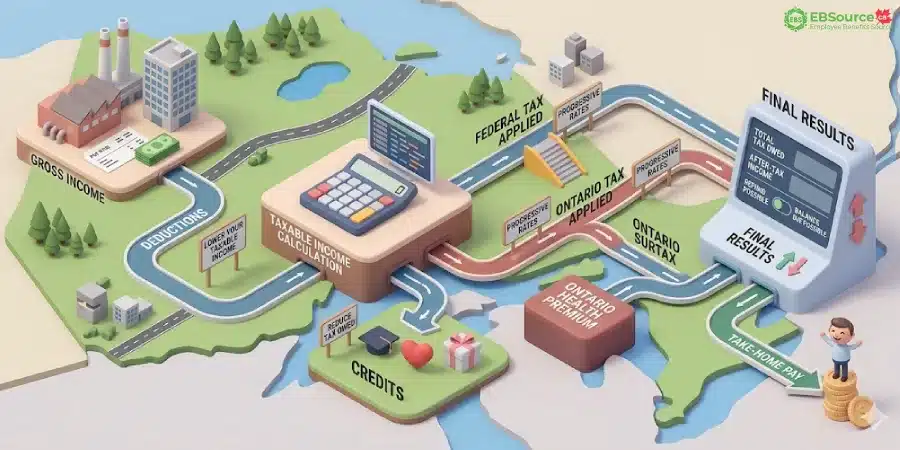
To accurately account for these complexities, the calculator operates in three steps. First, payroll contributions for CPP and EI are calculated based on gross earnings. Second, federal and provincial income taxes are determined using tax brackets, with eligible credits reducing the total amount owed. Third, the Ontario Health Premium is applied as a tiered charge. By following these steps in order, you can obtain a reliable estimate of income tax and net income based on any given gross pay amount.
Below, we will provide a detailed explanation of all the rates, thresholds, and credits involved, and guide you through the complete gross-to-net calculation.
What is the Purpose of our Ontario Income Tax Calculator?
This Ontario income tax calculator is a free online tool that estimates your taxes owed and net pay based on your gross income. It is useful for employees checking their pay stubs, job seekers comparing offers across different provinces, or anyone planning an RRSP contribution to see the tax impact right away.
By applying current federal and provincial tax rates, this tool provides a detailed breakdown when you enter basic information, such as your annual salary and province of residence. It then generates a summary that includes federal income tax, Ontario provincial tax, CPP contributions, EI premiums, and your after-tax income.
What Key Factors Distinguish Ontario Income Tax from Other Canadian Regions?
Ontario has specific levies that go beyond the standard income tax brackets, which can significantly affect your tax bill and result in changes of hundreds or even thousands of dollars. These factors include the distinctive Ontario Provincial Tax Brackets, the Ontario Surtax, and the Ontario Health Premium.
Here are the components you need to consider when working out your net income in Ontario:
Ontario Provincial Tax Brackets
Your income in Ontario is divided into 5 tax brackets, each with its own marginal rate, as specified by the Ontario government. This means that if your income increases and you enter a higher tax bracket, only the portion of your income that falls within that new bracket is taxed at the higher rate.
The five tax brackets for Ontario in 2026 are as follows:
- 5.05% on the first $53,891 of taxable income
- 9.15% on income from $53,891 to $107,785
- 11.16% on income from $107,785 to $150,000
- 12.16% on income from $150,000 to $220,000
- 13.16% on income over $220,000
Ontario Surtax
The Ontario surtax is an additional tax applied to your basic provincial tax rather than directly on your income. It significantly increases the effective tax rate for middle and upper-income earners.
For the year 2026, a 20% surtax applies to basic provincial tax over $5,818, with an additional 36% surtax on amounts over $7,446. This results in a combined surtax of 56% at the highest tier, raising the top Ontario marginal tax rate from 13.16% to 20.53% (13.16% × 1.56).
Our online tax calculators automatically include the surtax in the results. However, if you use a basic bracket table showing only the five Ontario tax rates (5.05% to 13.16%), be aware that these rates do not reflect your actual provincial tax burden once the surtax is applied.
Ontario Health Premium
The Ontario Health Premium is an additional charge based on income, paid through the income tax system. You are required to pay this premium if your taxable income exceeds $20,000. Importantly, the $20,000 threshold is not adjusted for inflation, meaning that as wages rise, more workers will be subject to this charge each year.
The premium increases in tiers as your income rises. According to the CRA’s T4032-ON payroll deductions table, the 2026 schedule is as follows:
- $0 for incomes of $20,000 or below
- Up to $300 for incomes between $20,001 and $36,000
- Up to $450 for incomes between $36,001 and $48,000
- Up to $600 for incomes between $48,001 and $72,000
- Up to $750 for incomes between $72,001 and $200,000
- $900 once taxable income exceeds $200,600; between $200,000 and $200,600, the premium rises from $750 to $900.
For employees, the premium is typically included automatically in payroll tax deductions. As a result, your actual take-home pay may be slightly lower than when you exclude it entirely from marginal rate displays.
Source: Payroll Deductions Tables – CPP, EI, and income tax deductions – Ontario – Government of Canada
Federal and Ontario Marginal Tax Rates
Ontario’s marginal tax rates indicate the tax on the next dollar earned, instead of a single rate for all income. The following table shows the combined federal and Ontario marginal tax rates for ordinary income in 2026. These rates include the Ontario surtax where applicable but do not include the Ontario Health Premium, which is charged separately.
| 2026 taxable income range | Ontario provincial rate before surtax | Combined federal and Ontario marginal rate | What this means |
| $0 to $53,891 | 5.05% | 19.05% | Most lower-income earners are taxed at the lowest Ontario rate, before credits reduce tax payable. |
| Over $53,891 to $58,523 | 9.15% | 23.15% | The 2nd Ontario bracket starts before the 2nd federal bracket begins. |
| Over $58,523 to $94,907 | 9.15% | 29.65% | Federal tax rises to 20.5%, increasing the combined marginal rate. |
| Over $94,907 to $107,785 | 9.15% plus surtax impact | 31.48% | Ontario surtax begins for a person claiming only the BPA. |
| Over $107,785 to $111,814 | 11.16% plus surtax impact | 33.89% | The 3rd Ontario bracket applies, and the surtax continues to raise the effective rate. |
| Over $111,814 to $117,045 | 11.16% plus higher surtax impact | 37.91% | The 2nd Ontario surtax threshold begins, adding another layer to provincial tax. |
| Over $117,045 to $150,000 | 11.16% plus surtax impact | 43.41% | Federal tax moves into the 26% bracket, creating a larger jump in combined tax. |
| Over $150,000 to $181,440 | 12.16% plus surtax impact | 44.97% | Ontario’s 4th bracket applies to income above $150,000. |
| Over $181,440 to $220,000 | 12.16% plus surtax impact | 48.26% | Federal tax moves into the 29% bracket. |
| Over $220,000 to $258,482 | 13.16% plus surtax impact | 49.82% | Ontario’s top provincial bracket begins. |
| Over $258,482 | 13.16% plus surtax impact | 53.53% | The top federal bracket applies, creating Ontario’s highest combined marginal rate. |
For calculator users, marginal tax rates show how much tax is paid on an additional dollar of income, like a bonus or overtime, but they are not the same as the average tax rate. For example, someone earning $120,000 does not pay 43.41% on every dollar. Instead, different portions of their income are taxed at different rates, with credits and other deductions applied to determine their final take-home pay.
Ontario Tax Credits and Deductions
Most of these Ontario tax credits are non-refundable, which means they can reduce your tax liability to zero but generally do not generate a refund on their own. When calculating payroll, employers use Form TD1ON to determine which Ontario personal credits to include when estimating provincial tax deductions from employee pay.
The table below lists the main Ontario personal tax credit amounts for 2026 that commonly affect payroll deductions and yearly tax calculations.
| Ontario credit or deduction item | 2026 amount or rule |
| Basic personal amount | $12,989 |
| Age amount | Up to $6,342 |
| Pension income amount | Up to $1,796 |
| Disability amount | $10,494 |
| Spouse or common-law partner amount | Up to $11,029 |
| Amount for an eligible dependent | Up to $11,029 |
| Ontario caregiver amount | Up to $6,122 |
| Amounts transferred from spouse or common-law partner | Depends on unused amounts |
| Amounts transferred from a dependent | Depends on unused disability amount |
| RRSP contributions, child care expenses, employment expenses, charitable donations, and tuition carried forward | Depends on eligibility and the amount claimed |
What is our Ontario After-tax Income Calculator Procedure?
Calculating your Ontario gross-to-net income starts with one core formula: your gross salary minus deductions from the gross pay.
In Ontario, workers have three types of deductions. First, there are payroll contributions, such as EI and CPP payments, including additional CPP for higher earnings. Second, income taxes are calculated using federal rates, which can be reduced by credits. Finally, Ontario adds a tiered Health Premium based on income.
Be aware that EI and CPP deductions differ based on income level, which is divided into 3 categories.
- If you earn between $3,500 and $74,600, both EI and CPP are taken as a percentage of your pay because you have not reached the yearly limit.
- If your income is between $74,600 and $85,000, EI and CPP are set at fixed amounts since you have reached the maximum. For any earnings above the yearly maximum, a CPP2 contribution is added.
- If you make more than $85,000, the CPP2 contribution is limited to $416 each year.
Each case is explained in detail below:
Case 1: Income from $3,500 to $74,600
For residents of Ontario with an annual gross income between $3,500 and $74,600, both EI and CPP contributions are calculated as a percentage of earnings, as neither has reached its annual cap. In addition to the standard federal and provincial tax brackets, Ontario also includes a provincial surtax and the Ontario Health Premium, which are taken into account in the following steps:
| Step | Description | Details |
| 1 | Determine your gross income | See the pay amount that appears on your pay stub |
| 2 | Determine the required gross annual pay | Multiply the amount that users entered by the chosen pay period (Step 1 x pay periods) |
| 3 | Calculate EI | 0.0163 x step 2 |
| 4 | Calculate CPP contributions | 0.0595 x (Step 2 – 3,500) |
| 5 | Calculate CPP additional contribution | Step 2 x (0.0100/0.0595) |
| 6 | Calculate the Taxable Income | Step 2 + Other income in a year + Vacation pay + Bonus – Tax deductions, reductions, non-refundable credits in a year – step 5 |
| 7 | Calculate federal income tax | Step 7.1 – step 7.2 |
| 7.1 | Basic federal tax | Calculate tax from step 6 |
| 7.2 | Federal tax credits | Calculate tax from (Step 7.2.1 + step 7.2.2 + step 7.2.3 + step 3) |
| 7.2.1 | Federal basic personal amount | |
| 7.2.2 | CPP base contributions | Step 4 x (0.0495/0.0595) |
| 7.2.3 | Canada employment amount | 1,501 |
| 8 | Calculate provincial income tax | Step 8.1 + step 8.1.1 + step 8.1.2 – step 8.2 |
| 8.1 | Basic provincial tax | Calculate tax from step 6 |
| 8.1.1 | Add provincial surtax | Depends on step 8.1 |
| 8.1.2 | Add the Ontario health premium | Depends on step 7 |
| 8.2 | Provincial tax credits | Calculate tax from (Step 8.2.1 + step 7.2.2 + step 3 + step 8.2.2 + step 8.2.2) |
| 8.2.1 | Provincial basic personal amount | $12,989 |
| 9 | Total federal and provincial tax deductions for the year | Step 3 + step 4 + step 7 + step 8 |
| 10 | Net income for the year | Step 2 – step 9 |
| 11 | Net income for the pay period | Step 10 / pay period |
Case 2: Income from over $74,600 to $85,000
Once your annual gross income in Ontario exceeds $74,600 but remains below $85,000, your EI and CPP base contributions are capped at their annual maximums. This means they will appear as fixed amounts instead of percentages. Additionally, a CPP2 contribution is introduced for earnings above the YMPE. The surtax and the Ontario Health Premium will still apply, as detailed in the table below:
| Step | Description | Details |
| 1 | Users enter required fields | Choose province/territory name |
| 2 | Determine the required gross annual pay | Multiply the amount that users entered by the chosen pay period (Entered amount x pay periods) |
| 3 | Calculate EI | 1,123.07 |
| 4 | Calculate CPP contributions | 4,230.45 |
| 5 | Calculate CPP additional contribution | 711 |
| 6 | Calculate CPP2 | 0.04 x (Step 2 – 74,600) |
| 7 | Calculate the Taxable Income | Step 2 + Other income in a year + Vacation pay + Bonus – Tax deductions, reductions, non-refundable credits in a year – 711 – step 6 |
| 8 | Calculate federal income tax | Step 8.1 – step 8.2 |
| 8.1 | Basic federal tax | Calculate tax from step 7 |
| 8.2 | Federal tax credits | Calculate tax from (Step 8.2.1 + step 8.2.2 + step 8.2.3 + step 3) |
| 8.2.1 | Federal basic personal amount | |
| 8.2.2 | CPP base contributions | 3,519.45 |
| 8.2.3 | Canada employment amount | 1,501 |
| 9 | Calculate provincial income tax | Step 9.1 + step 9.1.1 + step 9.1.2 – step 9.2 |
| 9.1 | Basic provincial tax | Calculate tax from step 7 |
| 9.1.1 | Add provincial surtax | Depends on step 9.1 |
| 9.1.2 | Add Ontario health premium | Depends on step 7 |
| 9.2 | Provincial/Territorial tax credits | Calculate tax from (Step 9.2.1 + step 8.2.2 + step 3 + step 9.2.2) |
| 9.2.1 | Provincial basic personal amount | $12,989 |
| 10 | Total federal and provincial tax deductions for the year | Step 3 + step 4 + step 6 + step 8 + step 9 |
| 11 | Net income for the year | Step 2 – step 10 |
| 12 | Net income for the pay period | Step 11 / pay period |
Case 3: Income over $85,000
When your annual gross pay in Ontario exceeds $85,000, the steps to calculate net income remain the same as in case 2. However, note that CPP2 has a maximum amount of $416.
FAQs about the Ontario income tax calculator
How does Ontario’s surtax work?
Ontario’s surtax is added to your basic provincial income tax, not directly to your income. In 2026, the surtax is 20% on the basic tax over $5,818 and 36% on the tax over $7,446. If your basic tax exceeds $7,446, the total surtax rate becomes 56%. This makes the effective provincial tax rate much higher for moderate- to high-earners.
How much CPP does a self-employed Ontario worker contribute?
With very few exceptions, every person over the age of 18 who works in Canada (outside of Quebec) and earns more than $3,500 per year is required to contribute to the CPP. If you are self-employed, you are responsible for making the entire contribution.
The contribution rate for pensionable earnings is 11.9%, which consists of 9.9% for the base CPP and an additional 2% for the first component of the CPP enhancement. This rate is split equally between the employee and the employer. For self-employed workers, since they pay both portions, their effective contribution rate is 11.9% on earnings from $3,500 up to the YMPE, which is $74,600.
What forms do Ontario residents use to calculate their provincial tax when filing their annual return?
Residents of Ontario use Form ON428 (Ontario Tax) to calculate the provincial taxes and credits to report on their tax return. Additional forms include Form ON-BEN for the Ontario Trillium Benefit and the Ontario Senior Homeowners’ Property Tax Grant, Schedule ON428-A for the Low-Income Individuals and Families Tax Credit, and Schedule ON479-A for the Ontario Childcare Access and Relief from Expenses Tax Credit.
