


The Civic Holiday is a popular summer holiday enjoyed across much of Canada on the first Monday of August. Unlike national holidays like Canada Day, the Civic Holiday is not a federal statutory holiday in Canada. This means whether you get a paid day off depends entirely on where you live and work. For some, it’s a legal right; for others, it’s a welcome but unofficial break.
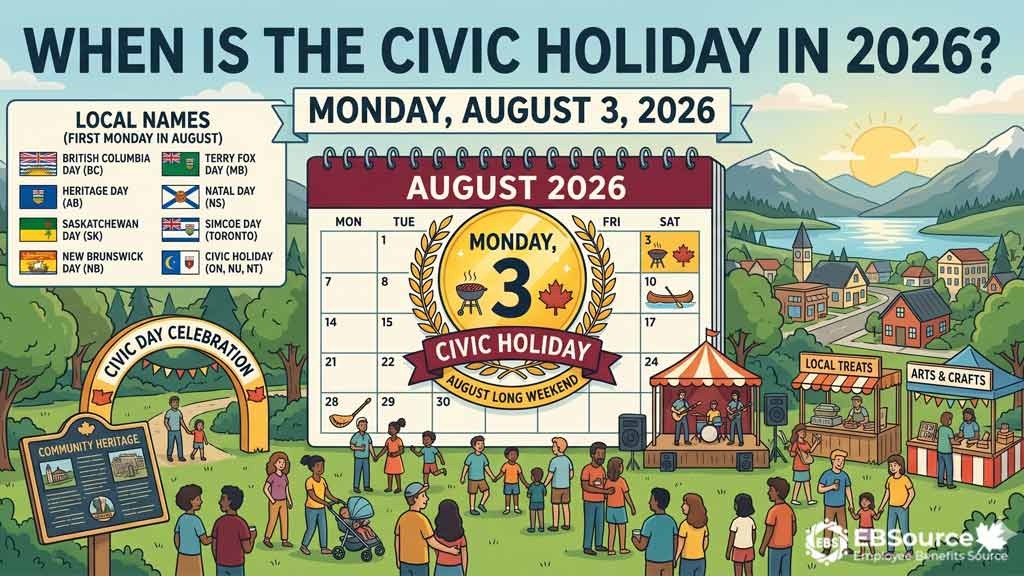
Most provinces and cities celebrate the day under a unique regional name that reflects local history and culture. You might know it as British Columbia Day, New Brunswick Day, or Simcoe Day in Toronto and Terry Fox Day in Manitoba. Regardless of the name, Canadians across the country mark the long weekend with outdoor festivals, community gatherings, and summer travel.
When is the Civic Holiday in 2026?
In 2026, the Civic Holiday falls on Monday, August 3. The date is always the first Monday of August, so it changes year to year, shifting within the August 1-7 window.
The following table shows the Civic Holiday date for five consecutive years:
| Year | Date |
| 2026 | Monday, August 3 |
| 2027 | Monday, August 2 |
| 2028 | Monday, August 7 |
| 2029 | Monday, August 6 |
| 2030 | Monday, August 5 |
Is the Civic Holiday a Statutory Holiday?
The Civic Holiday (the first Monday in August) is NOT a nationwide statutory holiday in Canada. Whether or not it is legally recognized is determined entirely by provincial and territorial labour laws.
Only British Columbia, Saskatchewan, New Brunswick, the Northwest Territories, and Nunavut mandate Civic Holiday as a statutory holiday. In provinces without statutory protection, including Alberta, Manitoba, Ontario, Nova Scotia, and Prince Edward Island, the decision is left to individual employers. They may choose to offer Civic Holiday as a paid day off or skip it entirely.
Meanwhile, Quebec and Yukon do not observe the Civic Holiday. Yukon instead celebrates Discovery Day on the third Monday in August, while municipalities in Newfoundland and Labrador observe civic holidays on different dates.
The table below summarizes the legal status of Civic Holiday by jurisdictional category.
| Status | Provinces/Territories |
| Statutory | BC, SK, NB, NT, NU |
| Not Statutory | ON, AB, MB, NS, PE, NL |
| Not Observed | QB, YT |
Who Gets a Paid Day Off on the Civic Holiday?
Whether you receive a paid day off depends entirely on whether the province you work in designates the first Monday in August as a statutory or general holiday, as well as the regulatory body that governs your workplace.
Identify which of these three categories applies to your role:
Provinces with a Statutory Holiday
Generally, you get paid time off if you work in a province that recognizes it as a statutory holiday, for a federally regulated employer outside Quebec and Yukon, or if your employer decides to recognize it as a holiday.
In a province where the Civic Holiday is a full statutory holiday (British Columbia, Saskatchewan, New Brunswick, Northwest Territories, or Nunavut), your employer must provide eligible employees with a paid day off. If you are required to work on a statutory holiday, you are typically entitled to premium pay (often 1.5 times your regular rate) or a substitute day off, depending on the province’s employment standards legislation.
Non-Statutory Provinces
For workers in Ontario, Manitoba, Alberta, and Nova Scotia, the Civic Holiday’s non-statutory status means provincially regulated employers are not required by law to give this day off.
While many professional offices and municipal services close, retail and service workers are generally not entitled to holiday pay unless it is specifically written into their employment contract or collective agreement.
Federally Regulated Employees
Federally regulated employees who work in the private sector, like banks, telecommunications companies, airlines, and interprovincial transport, do not automatically receive a paid day off. However, federal public service employees generally receive a day off through collective agreements.
How Canadians Celebrate the Civic Holiday Long Weekend
Most Canadians mark the Civic Holiday with community festivals, outdoor gatherings, camping, and fireworks. The holiday reflects Canada’s enjoyment of summer outdoors and community bonding.
Here are 4 common activities during the August long weekend:
Attend Community Festivals: Different provinces have their own special festivals, such as Toronto’s Caribbean Carnival and Edmonton’s Heritage Festival. In Manitoba, communities pay tribute to Terry Fox with fundraising runs and cancer awareness events.
Host Outdoor Gatherings: Canadians often enjoy summer barbecues by grilling outside and hosting family and neighbours. Additionally, many communities hold free outdoor concerts and entertainment.
Go Camping: Nature is a massive draw, with popular spots like Ontario’s Muskoka region and BC’s Okanagan Valley often booking months in advance for long weekends.
Watch Fireworks: Many towns put on professional pyrotechnic displays. To get the best view, families arrive early with chairs, blankets, and ear protection for the little ones, enjoying live performances that light up the night sky.
This is a very busy day on Canadian highways due to numerous weekend vacationers. Campgrounds, cottage country, and provincial parks experience some of the highest booking volumes of the summer, so early reservations are advisable.
What’s Open and Closed on the Civic Holiday?
Business operations depend heavily on whether the Civic holiday is statutory or optional in that region. While essential services remain fully operational, most banks, government and municipal offices, and public libraries are closed, making it important to plan your errands and travel in advance.

To help you navigate the August 2026 long weekend, here is how services are typically categorized:
Major banks: RBC, TD, Scotiabank, BMO, and CIBC often close branches on local holidays. Check your bank’s holiday schedule, like how National Bank observes Civic Day on August 4, except in Quebec and PEI. However, online banking and ATMs remain available everywhere.
Government Offices: Closed in statutory provinces and for most provincial employees elsewhere; municipal offices often close regardless of provincial status through local council decisions or union agreements.
Libraries and Recreation Centres: Usually closed in statutory provinces; in non-statutory areas, schedules vary, with many closing for the long weekend regardless of legal requirements.
Retail and Restaurants: Statutory provinces see many closures with exceptions for tourism/essential retail; non-statutory provinces generally maintain regular Monday operations with individual business discretion.
Border services: Maintain regular operations as an essential service, though expect longer wait times due to increased long weekend travel.
Liquor/Cannabis Stores: Closed in most statutory provinces (confirmed locally as some allow limited hours); open with regular or reduced hours in non-statutory provinces.
Public Transit: Major systems (TTC, TransLink, OC Transpo) run Sunday/holiday schedules in both statutory and non-statutory provinces.
Specifically, tourist areas usually stay open during holidays to take advantage of the long weekend traffic. When planning for the August 4 holiday, make sure to check which services are available in your area.
How is the Civic Holiday Called Across Canada?
The term “civic” itself reflects this municipal character. Nearly every province and territory in Canada observes the first Monday in August under a different name.
While the name Civic Holiday is officially recognized in the Northwest Territories, Nunavut, and broadly across Ontario, some other provinces, territories, and cities have adopted it on their own terms and given it a locally meaningful name. Each name honours a different historical figure or concept tied to the local community:
British Columbia: British Columbia Day. The province uses the day to celebrate its provincial identity and history.
Alberta: Heritage Day. It was established in 1974 to celebrate the province’s diverse cultural heritage,
Ontario: Broadly known as the Civic Holiday. However, many municipalities have their own names:
- Toronto: Simcoe Day. Honours John Graves Simcoe, who founded the town of York (now Toronto) and was a leading proponent of the Act Against Slavery of 1793.
- Ottawa: Colonel By Day. Celebrates Lieutenant-Colonel John By, the military engineer who supervised the construction of the Rideau Canal and founded Bytown (now Ottawa).
- Burlington: Joseph Brant Day. Dedicated to Thayendanegea (Joseph Brant), a Mohawk chief, military leader, and diplomat who served as a bridge between Indigenous people and the British Crown.
- Guelph: John Galt Day. Honours John Galt, a Scottish novelist and city founder.
- Oshawa: McLaughlin Day. Honours Robert McLaughlin, founder of the McLaughlin Carriage Co.
Where no local name is used, it is simply called the Civic Holiday.
Saskatchewan: Saskatchewan Day. The province celebrates its anniversary on this day.
Manitoba: Terry Fox Day. Named in 2015 to honour the Manitoba-born athlete and cancer research activist.
New Brunswick: New Brunswick Day. First celebrated in 1975 to honour the province.
Nova Scotia and PEI: Natal Day. The word “natal” means “birth.” This name celebrates the founding or “birthday” of the community and province, rather than a single individual.
Newfoundland and Labrador: Varies heavily by municipality.
Under the Shops Closing Act, each municipality sets its own civic holiday date. In St. John’s, it is Regatta Day, typically the first Wednesday of August. Other communities use the first Monday in August, while some have not selected any date at all.
Northwest Territories & Nunavut: Civic Holiday. These are the only jurisdictions where “Civic Holiday” is the official statutory name.
This patchwork of names and legal classifications makes the Civic Holiday unique among Canadian holidays. It is the only major holiday in the country where the name, the level of legal protection, and the historical figure or event being honoured can all differ depending on which city or province you call home. For most Canadians, its practical effect is a welcome long weekend near the midpoint of summer.
Source: Celebrating your city this Civic Holiday? How do your city’s finances shape up? – statcan.gc.ca
Looking for details on other long weekends and paid days off? Check out our guides to Canada’s statutory holidays:
- Labour Day
- Thanksgiving
- Remembrance Day
- New Year’s Day
- Family Day
- Good Friday
- Victoria Day
- National Day for Truth and Reconciliation
Legal disclaimer: This article offers general information and not legal advice. Rights and entitlements can differ based on location, agreements, and company policy, so check with your HR or local employment office for specifics.
FAQs about Civic Holiday in Canada
Can my employer force employees to work on the Civic Holiday?
It depends. In provinces where it’s a statutory holiday, they can, but they must pay you premium rates. In non-statutory provinces like Ontario, an employer can require you to work on a regular business day unless your contract states otherwise.
What if the holiday falls on my regular day off?
In statutory provinces, if you qualify for the holiday, you must be given another day off with pay or be paid for the holiday. In non-statutory provinces, there is no such requirement.
Do students or new employees get holiday pay?
It depends on the province. In Saskatchewan, there is no minimum employment period to qualify for holiday pay. In BC, you must have been employed for 30 days and worked for 15 of them. Students are generally entitled to the same rights as other employees.
What happens if I’m on vacation when the holiday occurs?
If you are in a statutory province and eligible, the day should not be counted as a vacation day. You should receive holiday pay or a substitute day off.
