



Victoria Day is a public holiday celebrated annually in Canada to honour Queen Victoria while marking the unofficial start of summer across the nation.
In 2026, Victoria Day in Canada falls on Monday, May 18, following the fixed rule that it is always observed on the last Monday before May 25.
Whether employees receive a paid day off depends on their province or territory, as Victoria Day is a paid statutory holiday in most but not all Canadian jurisdictions. Specifically, in provinces where it is recognized as a statutory holiday, eligible employees are generally entitled to holiday pay or a substitute day off. If employees are required to work, employers must provide premium pay or other compensation based on provincial employment standards.
For both Canadian employees and employers, it’s important to understand whether it is a statutory holiday, who gets paid, and what rules apply in each province.
What is Victoria Day?
Victoria Day is a federal public holiday in Canada that commemorates the birthday of Queen Victoria and also the official birthday of the reigning Canadian monarch.
Its roots stretch back to 1845, making it the oldest official holiday in Canada and one of the country’s most distinctive national observances.
Many Canadians also refer to it informally by names such as the “May Long Weekend,” “May Long,” and “May Two-Four”, which is a playful nod to both the date and the Canadian slang for a 24-pack of beer.
As a federal statutory holiday, Victoria Day is more than just a day off; it reflects Canada’s history, traditions, and the unofficial start of summer, including:
- Unofficial Start of Summer: For many Canadians, Victoria Day weekend signifies the transition from spring to summer, ushering in warmer weather for increased outdoor pursuits.
- Honouring Queen Victoria: The holiday commemorates Queen Victoria’s birthday and honours her legacy as the sovereign of Britain and its territories during Confederation.
- Celebrating the Monarchy: It upholds the centuries-old tradition of honouring the reigning monarch’s birthday in Canada as a member of the Commonwealth.
- Canadian Heritage: Victoria Day coincides with homegrown traditions like camping, gardening, cottaging, and community gatherings.
When is Victoria Day in 2026?
Victoria Day in 2026 falls on Monday, May 18, following the rule that it is observed on the last Monday before May 25.
This scheduling rule guarantees a three-day long weekend every year, and the specific date shifts slightly depending on where May 25 falls in the calendar.
That helps employers plan work schedules and allows families to arrange seasonal activities. After Victoria Day, gardeners can plant frost-sensitive crops, cottage owners can open their properties, and outdoor attractions start summer operations.
The following table outlines the upcoming Victoria Day dates from 2026 to 2030:
| Year | Date |
| 2026 | Monday, May 18th |
| 2027 | Monday, May 24th |
| 2028 | Monday, May 22nd |
| 2029 | Monday, May 21st |
| 2030 | Monday, May 20th |
Because the holiday always falls on a Monday, it guarantees a three-day long weekend for employees who work a standard Monday-to-Friday schedule.
Source: Victoria Day, Wikipedia
What Are Employee Rights on Victoria Day?
Eligible employees in provinces where Victoria Day is a paid statutory holiday are entitled to a day off with regular pay, and those required to work are owed premium compensation. In most jurisdictions, holiday pay is outlined as follows:
If not required to work on Victoria Day, full-time employees automatically receive pay for all statutory holidays. If Victoria Day is on a regular workday, you are paid your normal rate for the day off. If it falls on your scheduled day of rest, the holiday is moved to the next working day.
If required to work on Victoria Day, your employer must offer one of two compensation options:
- Option 1: Get paid for the holiday plus 1.5 times your regular pay for hours worked.
- Option 2: Get your regular pay for hours worked and a paid day off to use later.
The paid day off must be taken within a specific time, typically 3 months after Victoria Day, unless you have a written agreement allowing up to 12 months.
The table below shows who qualifies, how holiday pay is calculated, what employees receive if they work, and the rules for a substitute day off across different provinces and territories in Canada.
| Province/Territory | Eligibility Requirements | Pay Calculation | Premium Pay if Working | Substitute Day Rules |
| Federal (Canada Labour Code) | Most federally regulated employees | Total regular wages in the past 4 weeks (excluding overtime) / 20 | Public holiday pay + 1.5x regular wage | Within 3 months (12 months with agreement) |
| Ontario (ON’s ESA) | Work last scheduled shift before & after (or has cause) | (Regular wages + vacation pay in the past 4 weeks) / 20 | Public holiday pay + 1.5x regular wage (employee chooses if agreed in writing) | Within 3 months (12 months with agreement) |
| British Columbia (BC’s ESA) | Employed for 30 calendar days and worked/earned wages on 15 of the 30 days before the holiday | Total wages in the past 30 days/days worked. | 1.5x regular wage (double-time over 12 hours) + holiday pay | For another scheduled day off. |
| Alberta (AB’s Employment Standards) | 30+ workdays in prior 12 months; no absences without consent | Wages in the previous 4 weeks/days worked (employer chooses 4-week period) | 1.5x regular wage + average daily wage OR regular pay + future day off at average daily wage (employer chooses) | Before the next vacation (by agreement) |
| Saskatchewan (The Saskatchewan Employment Act) | Must be employed (no minimum period for new employees) | 5% of wages (excluding overtime) in 28 days (4 weeks) before the holiday | 1.5x regular hourly rate + holiday pay | Day off with pay within a reasonable time |
| Manitoba (MB’s Employment Standards Code) | No minimum period; missed shifts lead to loss of entitlement | 5% of gross wages in the past 4 weeks (or 1 day’s pay if consistent hours) | General holiday pay + 1.5x regular wage OR regular pay + future day off with general holiday pay (employer chooses) | Within 30 days OR before next vacation (by agreement) |
| Northwest Territories (NWT’s ESA) | Work for the same employer 30+ days in the past 12 months; must work the last shift before and the next shift after | Average day’s pay = total wages/days worked | Average day’s pay + overtime OR another day off with pay (employee entitled to choice) | Another paid day off or average day’s pay if not granted |
| Yukon (YT’s ESA) | 30+ days in the last 12 months; work or be available for the last shift before and the first shift after | Average day’s pay = wages in the past 30 days/days worked | Public holiday pay + 1.5x regular wage OR regular pay + substitute day off | Substitute a day off within 30 days or by agreement |
| Nunavut (NU’s Labour Standards Act) | Worked 30+ days in the last 12 months; worked the last shift before and the first shift after | Total wages in past 4 weeks/days worked | Holiday pay + 1.5x regular wage OR regular pay + substitute day | Within a reasonable time as agreed |
Examples of holiday pay on Victoria Day
Check out three examples below to understand how holiday pay works in different provinces and territories:
Federal Example: A part-time employee earned $1,800 in the 4 weeks before Victoria Day. Their holiday pay is calculated as (1/20 × $1,800) = $90. If they work 6 hours on that day, they will earn 1.5 times their regular pay for those hours.
Ontario Example: A full-time employee earned $3,200 in wages and $128 in vacation pay before Victoria Day, for a total of $3,328. Public holiday pay is calculated as $3,328 / 20 = $166.40. If the employee works 7 hours at $22/hour and chooses public holiday pay along with premium pay, their total pay would be $166.40 + (1.5 × $22 × 7) =$397.40.
British Columbia Example: An employee earned $3,000 for 15 days worked in the past 30 days; their holiday pay is ($3,000 / 15) = $200. When they work 13 hours, they receive holiday pay plus 1.5 times their regular rate for the first 12 hours and double their rate for the 13th hour.
Is Victoria Day a Statutory Holiday in Your Province?
Victoria Day is a statutory federal holiday under the Canada Labour Code, providing employees across the country with a paid day off. However, its status varies by province and territory. In Alberta, British Columbia, Saskatchewan, Manitoba, Ontario, Yukon, the Northwest Territories, and Nunavut, it is a paid statutory holiday. In contrast, it is not a paid holiday for private-sector employees in Nova Scotia, New Brunswick, Prince Edward Island, or Newfoundland and Labrador.
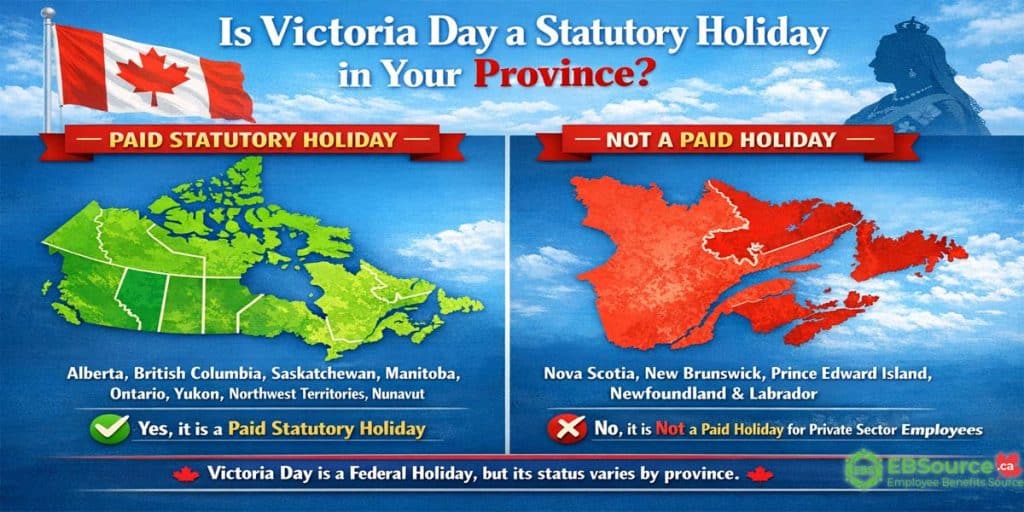
The difference comes down to whether a workplace is federally or provincially regulated, and which province or territory sets the rules. The table below shows where Victoria Day is recognized as a statutory holiday across Canada:
| Province/Territory | Status |
| Alberta | Statutory Holiday |
| British Columbia | Statutory Holiday |
| Manitoba | Statutory Holiday |
| Northwest Territories | Statutory Holiday |
| Nunavut | Statutory Holiday |
| Ontario | Statutory Holiday |
| Saskatchewan | Statutory Holiday |
| Yukon | Statutory Holiday |
| New Brunswick | Not Statutory |
| Newfoundland and Labrador | Not Statutory |
| Nova Scotia | Not Statutory |
| Prince Edward Island | Not Statutory |
In provinces and territories where Victoria Day is recognized as a statutory holiday, eligible workers are entitled to paid time off or extra pay if they have to work on the holiday.
Important Note: Quebec does not celebrate “Victoria Day.” Instead, it recognizes National Patriots’ Day on the same Monday before May 25. This day is a paid public holiday under Quebec’s labour laws, meaning eligible employees receive a paid day off or compensation in accordance with CNESST rules, even if the holiday has a different name.
How do Canadians Celebrate Victoria Day?
For many Canadians, Victoria Day weekend marks the start of summer. Across the country, people celebrate with outdoor activities, gardening, seasonal attractions, events, shopping, and time with family and friends. Common ways to celebrate include:
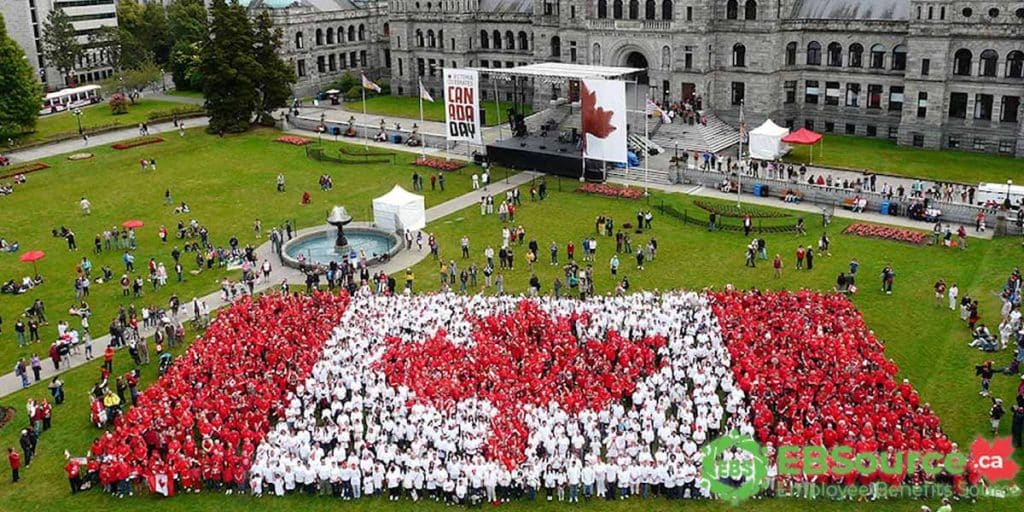
- Outdoor Activities: Parades, fireworks, barbecues, camping trips, beach visits, boating, hiking, and cottage openings are popular Victoria Day activities enjoyed by Canadians taking advantage of the warm May weather.
- Garden Planting: Gardeners often use the Victoria Day weekend to plant annual flowers, vegetable gardens, and other delicate plants outside since the risk of frost has generally passed by late May.
- Amusement Park Openings: Many amusement parks and outdoor attractions, such as Canada’s Wonderland, open for the summer season on Victoria Day weekend to attract holiday crowds.
- Sporting Events: Community sporting events like 10K runs, marathons, soccer tournaments, and cricket matches frequently occur on the holiday weekend.
- Retail Sales: To promote the unofficial start of summer, retailers offer Victoria’s Day sales on seasonal items such as summer clothing, outdoor living products, and gardening supplies.
- Family Gatherings: The long weekend allows families to reunite outdoors and host barbecues, picnics, or other events on the holiday.
How Did Victoria Day Originate in Canada?
The origins of Victoria Day in Canada can be traced back to the 1800s. In 1845, the legislative assembly of the Province of Canada declared May 25th a holiday to honour Queen Victoria’s birthday.
Queen Victoria was born on May 24th, 1819 and ascended the British throne in 1837 at the age of 18. She ruled for 63 years as Queen of the United Kingdom of Great Britain and Ireland until her death in 1901.
Although Queen Victoria never visited Canada, her role was significant to the Confederation. Her father, Prince Edward, resided in Quebec and Halifax for nearly a decade prior to her reign.
After Queen Victoria’s death in 1901, the Parliament of Canada officially named May 24th as Victoria Day that same year. It became a national holiday to pay tribute to Victoria’s role in Confederation and her selection of Ottawa as the nation’s capital.
In 1952, Victoria Day was fixed to occur annually on the Monday before May 25th, creating the modern three-day weekend that Canadians now enjoy. This adjusted the date while allowing the holiday to remain near Queen Victoria’s birthday.
Canada is a multicultural country that celebrates many holidays and festivals throughout the year. Some of the major Canadian holidays include:
- New Year’s Day
- Family Day
- Good Friday
- Easter
- Canada Day
- Civic Holiday
- Labour Day
- Thanksgiving Day
- Remembrance Day
- Christmas Day
- Boxing Day
Legal note: This guide outlines the basic legal requirements, but keep in mind that collective agreements or company policies may offer better terms. Always check the specific laws or official government sources for confirmation.
Victoria Day is a uniquely Canadian public holiday celebrating Queen Victoria’s birthday and the unofficial beginning of summer nationwide. Canadians commemorate the date with fireworks, parades, outdoor recreation, and community events that coincide with the arrival of warmer weather.
The long weekend provides a chance to open cottages, plant gardens, shop seasonal sales, and partake in beloved Canadian pastimes with friends and family. Though originally honouring Queen Victoria’s role in Confederation, the holiday has evolved into a landmark event for the summer kickoff.
FAQs related to Victoria Day in Canada
Why is Victoria Day a holiday in Canada?
In 1845, Queen Victoria's birthday was declared a holiday by the legislative assembly of the Province of Canada. In 1901, it was officially named Victoria Day after her death to commemorate her rule.
Is Victoria Day a statutory holiday everywhere in Canada?
It is a statutory holiday federally and in most provinces/territories but not in New Brunswick, Newfoundland, Nova Scotia, and Prince Edward Island. Quebec celebrates National Patriots' Day instead.
What does "May two-four" mean for Victoria Day?
"May two-four" is a nickname for Victoria Day that references both May 24th and a case of 24 beers, referring to the long weekend's drinking culture.
Are there any major events on Victoria Day weekend?
Major events include fireworks displays, cultural festivals, ship tours, amusement park openings, sporting events, street festivals, and retail sales/promotions.
When is Victoria Day in 2026?
Victoria Day in 2026 will be on Monday, May 18th.
Do you get paid extra for working on Victoria Day?
In provinces where it's a statutory holiday, employees are entitled to general holiday pay if they work on Victoria Day.
Where are the biggest Victoria Day celebrations?
Major celebrations include fireworks at Toronto's Ashbridges Bay, parades in Victoria, BC, and large displays in Hamilton. Many cities host community events.
Why is Victoria Day important to gardeners?
After Victoria Day, gardeners can be reasonably sure there will be no more frost until autumn, making it safe to plant tender crops and flowers.
What's open on Victoria Day in Canada?
Most government offices, banks, and post offices close. Many retail stores close except in provinces without a statutory holiday designation. Tourist attractions, restaurants, and essential services typically remain open with holiday hours.
When was the first Victoria Day celebrated?
The first Victoria Day was celebrated in 1845 when the legislative assembly of the Province of Canada declared Queen Victoria's birthday (May 24) an official public holiday. It became a national holiday in 1901 after Queen Victoria's death.
What is Victoria Day for kids?
Victoria Day is a holiday celebrating Queen Victoria's birthday and the start of summer fun in Canada. Kids enjoy fireworks, parades, outdoor activities, and often have their first camping trips or visits to cottages. It means no school on Monday and lots of family time.