



When a loved one is facing a significant illness, many Canadians find it essential to take time off work to provide care and support. To ease the resulting financial strain, Employment Insurance (EI) Compassionate Care Benefits provide temporary income replacement for those who need to step away from their jobs to care for a family member who has a significant risk of death within the next 26 weeks.
To qualify for this support, you must meet key requirements related to your recent work hours, a decrease in earnings, and a medical certificate confirming your family member’s prognosis.
For 2026, the benefit pays 55 percent of your earnings, up to a maximum of $729 per week.
It is important to apply online through Service Canada as soon as you stop working. To avoid a potential loss of benefits, you should submit your application no later than four weeks after your last day of work.
To learn more about the specifics of this benefit, read the content below.
Who is Eligible for Compassionate Care Benefits?
To receive Compassionate Care Benefits, you must meet specific criteria established by Service Canada. Your application will be evaluated based on your work history, the impact on your earnings, and the medical situation of your family member.

To qualify for Compassionate Care Benefits, you must satisfy all of the following conditions:
- Work Hours: You need to have accumulated at least 600 insurable hours of work. This is roughly equivalent to 15 weeks of full-time work (40 hours/week). These hours must be within your “qualifying period,” which is either the last 52 weeks or the period since your last EI claim began, whichever is shorter.
- Decreased Earnings: Your regular weekly earnings must have decreased by more than 40% for at least one week because you have taken time away from work to provide care.
- Medical Certification: A medical doctor or nurse practitioner must certify that your family member has a serious medical condition with a significant risk of death within the next 26 weeks.
- Family Relationship: You must be a family member or be considered “like family” to the person who is gravely ill. The definition of a family member is broad and includes spouses, children, parents, siblings, grandparents, and in-laws, among others.
It is important to note that if you are already receiving other EI benefits, such as EI regular benefits after a layoff, you can still apply for and switch to Compassionate Care Benefits if a family member becomes gravely ill.
How Much Can You Receive from Compassionate Care Benefits
The benefit pays 55 percent of your average insurable earnings, up to a maximum of $729 per week in 2026, and payments are considered taxable income.
Your benefit amount is based on the annual Maximum Insurable Earnings (MIE), which is set at $68,900 for 2026. The MIE is the highest amount of annual income used to calculate your benefits. This means that even if you earn more than $68,900, your payment is calculated based on this ceiling.
If you are in a low-income family with children, you may be eligible for the EI Family Supplement, which can increase your benefit rate. To qualify, you must meet two conditions:
- Your net family income is $25,921 or less per year.
- You or your spouse receives the Canada Child Benefit.
This supplement can increase your benefit rate from 55% to as high as 80% of your average earnings, though it will not exceed the maximum weekly payment of $729. You do not need to apply for this separately; Service Canada will automatically assess your eligibility when you apply for benefits.
Source: https://publications.gc.ca/collections/collection_2011/servicecanada/SG5-57-2011-eng.pdf
How to Apply for Compassionate Care Benefits?
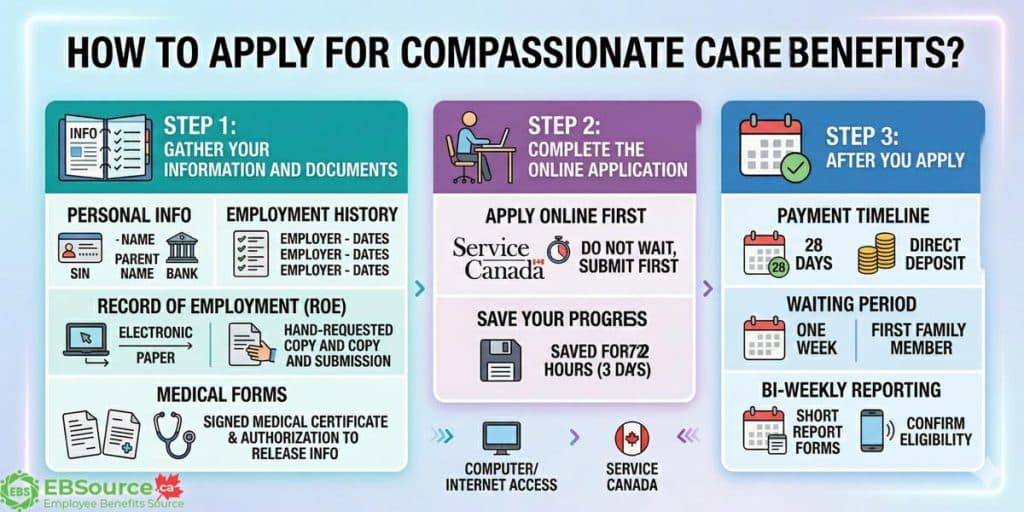
You must submit an online EI application through Service Canada as soon as you stop working, and no later than four weeks after your last day of work, to avoid losing benefits.
To be specific, you need to follow three steps: gather your information, complete the online form, and understand what happens after you apply.
Step 1: Gather Your Information and Documents
Before starting the online application, make sure you have three main items ready: your personal information, your employment history, and the required medical documentation. Here is what you will need for each:
- Personal Information: Your Social Insurance Number (SIN), one of your parents’ last names at birth, and your banking information for direct deposit.
- Employment History: Details for all employers you have worked for in the last 52 weeks, including names, addresses, and dates of employment.
- If your employer issues electronic ROEs, they are sent directly to Service Canada, and you do not need to do anything.
- If your employer issues paper ROEs, you must request copies and submit them to Service Canada as soon as possible.
- Medical Forms: You will need two forms signed by the ill person’s medical doctor or nurse practitioner: the Medical Certificate for Employment Insurance Compassionate Care Benefits and the Authorization to Release Medical Information.
Step 2: Complete the Online Application
The application should take about one hour to complete and can be done from any computer with internet access.
Go to the Service Canada website and start your application immediately. Do not wait to have all your documents ready. Submit your application first to meet the deadline, and then send the supporting documents as soon as you have them.
If you cannot finish the application in one session, you can save your progress. Your information will be saved for 72 hours (3 days), after which it will be deleted, and you will have to start over.
Step 3: After You Apply
Once your application is submitted, there are three key things to expect: when your payments may begin, whether a waiting period applies, and the ongoing reporting required to continue receiving benefits. Here is what to expect for each stage:
- Payment Timeline: If you are eligible and all required information has been received, you should get your first payment about 28 days after you apply. Signing up for direct deposit is the fastest and most reliable way to receive payments.
- Waiting Period: Before your benefits start, there is a one-week waiting period for which you will not be paid. This only needs to be served by the first family member who applies for benefits for the same person.
- Bi-weekly Reporting: To continue receiving benefits, you must complete a short bi-weekly report online or by phone. This report confirms your ongoing eligibility and is required for payments to continue. Service Canada will provide instructions on how to do this after your claim is approved.
When do compassionate care benefits conclude?
Compassionate Care Benefits are available within a 52-week window, providing eligible claimants with up to 26 weeks of support during this period. Payments may be continuous or intermittent until the endpoint, which could be when:
- The eligible claimant has reached the maximum number of weeks for which CCBs can be claimed, combined with other EI benefits.
- Fifty-two weeks have elapsed since the patient was certified as being critically ill or injured or requiring end-of-life care.
- The allowance for eligible claimants has been paid.
- The gravely ill family member has recovered or passed away.
Is your job protected during compassionate care leave?
Most territorial and provincial labour codes provide job protection for workers taking compassionate care leave.
During the leave, employers are required to maintain the employee’s group health and dental benefits, and the worker will be reinstated to their previous position or a comparable one once the leave ends.
However, the rules regarding eligible family members may vary, necessitating confirmation with the employer and the provincial/territorial government about the rights and obligations.
Combining Compassionate Care with Other EI Benefits
Employment Insurance (EI) program is designed to be flexible, allowing you to combine Compassionate Care benefits with other forms of support as your needs change.
Within a single 52-week benefit period, you can typically receive a combined total of up to 50 weeks of benefits. This applies when you claim Compassionate Care benefits alongside:
- EI Sickness benefits
- EI Maternity and parental benefits
- EI Regular benefits
A common and important scenario is the ability to switch from the Family Caregiver Benefit to Compassionate Care Benefits if the health of the person you are caring for declines, and they require end-of-life care.
It is important to note that the 50-week calculation can become more complex if you are also claiming extended parental benefits, as they are paid at a different rate. For a calculation tailored to your specific circumstances, it is always best to contact Service Canada directly.
Finally, there is a significant tax advantage to be aware of. Compassionate Care benefits are not subject to benefit repayment (often called “clawback”). This means that, unlike regular EI benefits, you will not have to repay any portion of your Compassionate Care benefits at tax time, regardless of your annual income.
FAQs about Compassionate Care Benefits
Can compassionate care benefits be extended to caring for a close friend?
Yes, compassionate care benefits can be extended to care for a seriously ill friend or other close individual. However, the patient or their legal representative must confirm on the attestation form that they consider the caregiver a family member.
What amount do compassionate care benefits entail?
The exact monetary value of compassionate care benefits under the CCB program can only be determined once the application is processed. Nevertheless, most recipients receive 55% of their average insurable weekly earnings, with a maximum limit of $650 per week in 2023. This base rate is used to calculate Employment Insurance (EI) benefits.
When can payments for compassionate care benefits commence?
If eligible for CCBs and after providing valid documentation, the first payment is typically disbursed 28 days after registration. If the claim is denied, the applicant will receive a notification with an explanation.
Is there a waiting period for compassionate care benefits?
Yes, a waiting period of one week is mandatory before receiving compassionate care benefits. This waiting period is similar to the deductible seen in other insurance types. However, waiting periods may be waived or postponed in certain cases. For instance, if family members share CCBs, the first claimant will serve the waiting period, while others won't. Only if the other family members later claim regular sickness, maternity, or parental benefits will they have to endure a waiting period.
Can compassionate care benefits be shared?
Yes, eligible family members, including the primary caregiver, can share the 26 weeks of compassionate care benefits. To do so, they need to coordinate the distribution of these benefits among themselves, considering the needs and duration of care required for the seriously ill family member.