



EI maternity and parental benefits provide you with money when you take time off work for your pregnancy, after giving birth, or to care for a newborn or newly adopted child.
In 2026, eligible workers can receive up to $729 per week through maternity or standard parental benefits, or up to $437 per week through extended parental benefits.
To receive these payments, you must apply online through Service Canada and demonstrate that you meet specific eligibility and timing requirements. Find out more below.
What EI Maternity and Parental Benefits Provide?
In Canada, the federal Employment Insurance (EI) program provides financial support to new parents through two different benefits: Maternity Benefits and Parental Benefits.
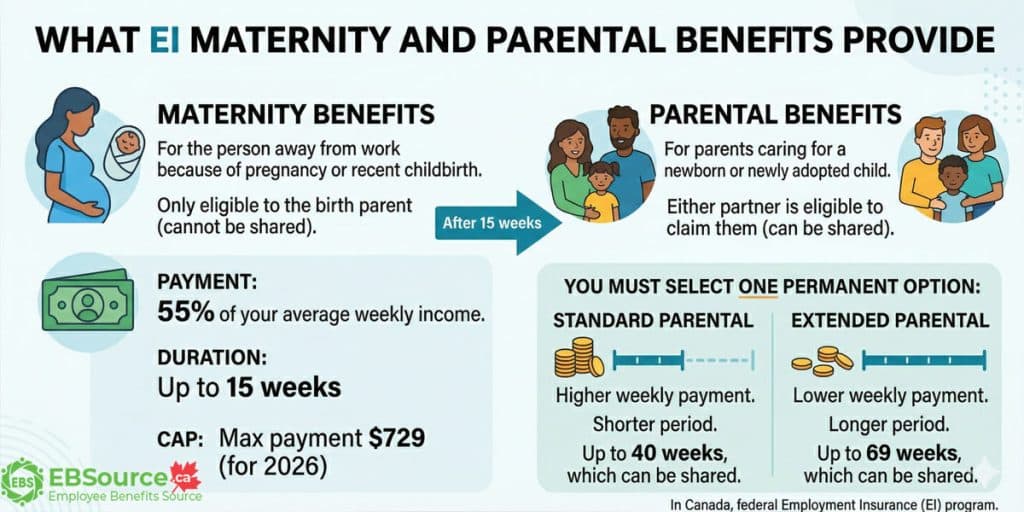
EI maternity benefits are designed specifically for the person who is away from work because they are pregnant or have recently given birth. Here are important points to know:
- Only the birth parent is eligible for these benefits; maternity benefits cannot be shared with a partner.
- This benefit pays 55% of your average weekly income for up to 15 weeks, with payments capped at $729 for 2026.
- The person receiving maternity benefits may also be eligible to claim parental benefits after the maternity benefits end.
Once your 15 weeks of maternity benefits have been paid, you can then begin to receive parental benefits.
EI Parental Benefits, on the other hand, are for parents caring for their newborn or newly adopted child, and either partner is eligible to claim them.
When you apply, you must select either Standard Parental or Extended Parental benefits. This one-time choice is permanent and affects both the payment amount and the duration of the benefits:
- Standard Parental: Provides a higher weekly payment over a shorter period (up to 40 weeks, which can be shared).
- Extended Parental: Provides a lower weekly payment over a longer period (up to 69 weeks, which can be shared).
This table compares the key differences between standard and extended parental benefits, including benefit rates, weekly maximums, claim periods, and the number of weeks available, so you can decide which option fits your family’s needs:
| Feature | Extended | Standard |
| Benefit rate | 55% of insurable earnings | 33% of insurable earnings |
| Maximum weekly amount (2026) | $729 | $437 |
| Maximum weeks (one parent) | 35 | 61 |
| Maximum weeks (shared between parents) | 40 | 69 |
| Must claim within | 52 weeks of birth or placement | 78 weeks of birth or placement |
Application Tip: To save time, birth parents can apply for parental benefits at the same time they apply for maternity benefits.
Source: EI maternity and parental benefits: What these benefits offer – canada.ca
Who Qualifies for EI Maternity and Parental Benefits?
To receive EI maternity or parental benefits, you must meet three key eligibility conditions related to your personal situation, loss of earnings, and insured work hours.
Here are the main requirements you must meet in detail:
Your Personal Situation
Your eligibility depends on the type of benefit you are applying for:
- For maternity benefits, your personal situation must be that you are the one who is pregnant or has recently given birth.
- For parental benefits, your situation involves taking time off to care for your new or adopted child.
A Significant Decrease in Earnings
You must be experiencing a work stoppage that has caused your regular weekly earnings to decrease by more than 40% for at least one week.
Sufficient Work Hours
You must have accumulated at least 600 hours of insurable employment during your “qualifying period.”
This is the shorter of these two timeframes: the 52 weeks immediately before your claim starts, OR the period since your last EI claim began. For most people, this will be the 52 weeks before they apply.
How to Apply for EI Maternity and Parental Benefits
You apply online through the Service Canada website as soon as you stop working, even if your employer has not yet issued your Record of Employment, since delays can reduce the number of benefit weeks you receive.
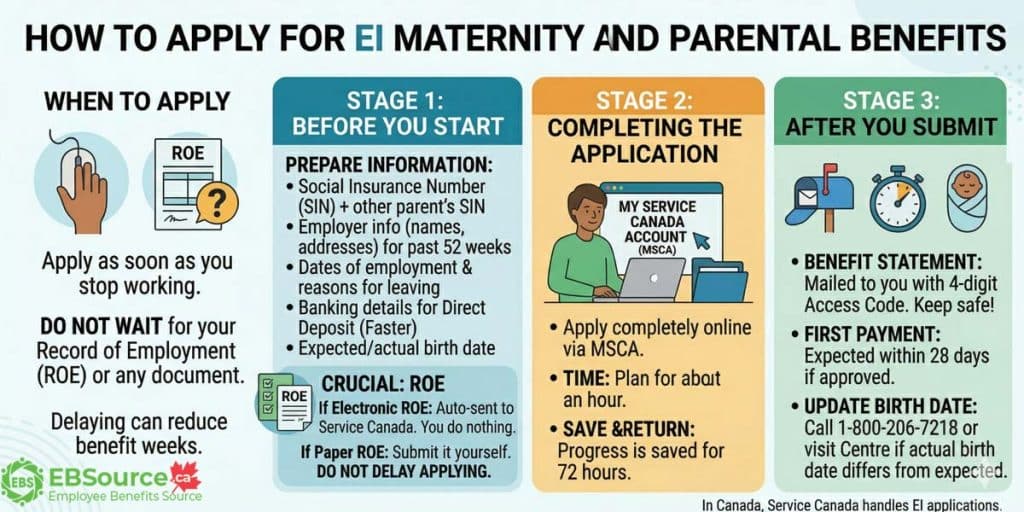
To help you through the process, here are the three main stages to understand: what to prepare before you start, how to complete the online application, and what to expect after you submit.
Before You Start
Make sure you have the following information to complete your application:
- Your employer’s information from the last year (names and addresses) in the past 52 weeks
- Your Social Insurance Number (SIN), plus any other parent’s SIN if you are sharing benefits
- The dates you were employed with each employer, along with the reasons you are no longer working there
- Your banking details for direct deposit (highly recommended for faster payments)
- The expected or actual date of birth of your child
Besides the above documents, the single most important document for your application is your Record of Employment (ROE).
If your employer files ROEs electronically, you don’t need to do anything else, as Service Canada receives them directly. If you get a paper ROE, you must submit it yourself by mailing it or dropping it off at a Service Canada Centre. Do not hold off on applying while you wait for the ROE or any other document.
Completing the Online Application
The best time to apply is right after you stop working. You can complete the entire application online through your My Service Canada Account (MSCA). Keep these practical details in mind:
- Time Commitment: Set aside about an hour to complete the form.
- Saving Your Progress: If you get interrupted, don’t worry. The system will save your application for 72 hours, allowing you to return and finish it later.
After You Submit
Once your application is submitted, here is what you can expect:
- Benefit Statement and Access Code: Service Canada will mail you a benefit statement containing a 4-digit access code. Keep this code safe, as you will need it along with your SIN to check the status of your application.
- First Payment: If your application is approved and all your documents (like your ROEs) have been received, you can typically expect your first payment within 28 days.
- Update Your Child’s Birth Date: If your baby’s actual date of birth is different from the expected due date you provided on your application, you must inform Service Canada as soon as possible. You can do this by calling 1-800-206-7218 or by visiting a Service Canada Centre in person.
What If You Had a Recent EI Claim?
If you received any type of EI benefits within the past 52 weeks, it can impact your new maternity or parental claim. You may be faced with a choice: reactivating your old claim or starting a completely new one.
This decision is critical because it can significantly change the total number of benefit weeks you’re entitled to. For example, starting a new claim might grant you the maximum number of weeks if you’ve worked enough new hours, while reactivating an old one might not.
Because this can be a complex situation, the best course of action is to contact Service Canada before you apply. An agent can review your file and help you determine which option will be most beneficial for you.
Tax Implications of EI Maternity and Parental Benefits
All EI maternity and parental benefits are taxable income, with federal and provincial or territorial taxes deducted at source when payments are issued.
Tax deductions at source
Service Canada automatically withholds federal and provincial or territorial income tax from each benefit payment.
The amounts you receive every two weeks are net of tax, much like a paycheque. However, the withholding may not perfectly match your year-end liability, especially if you earned significant employment income earlier in the year. Plan for the possibility of a balance owing or a refund when you file.
T4E slip: The Official Tax Slip
You will receive a T4E slip each year detailing benefits paid and taxes withheld.
Benefits are taxable in the year they are paid, not the year the claim begins. For example, if your claim started in late December 2024 but your first payment didn’t arrive until January 2025, that income is part of the 2025 tax year and will appear on your T4E slip for 2025.
You can get your T4E either online or by mail:
- Online: The fastest way to get your T4E is through your My Service Canada Account (MSCA). Slips are typically available online in early February.
- By Mail: If you opt for mail delivery, you can expect to receive your T4E before the middle of March. If it hasn’t arrived by then, you should contact Service Canada.
Other Benefits You May Access During Leave
Your eligibility for EI doesn’t necessarily stop with maternity and parental benefits. Life is unpredictable, and you may be able to access other types of support if your circumstances change. For example, you could apply for:
- EI Sickness benefits if you experience a personal illness or injury.
- EI Caregiving benefits if your child becomes critically ill or injured and requires your care.
It’s important to know that each type of benefit has its own specific eligibility requirements that you must meet.
Normally, there is a limit of 50 weeks of benefits within a 52-week period. However, the rules are more flexible for new parents. When maternity or parental benefits are combined with other special benefits (like sickness or caregiving), the maximum duration for which you can receive payments can increase significantly, potentially up to 102 weeks.
Frequently Asked Questions about EI Maternity and Parental Benefits
Do I get more benefit weeks if I have twins or triplets?
No, the number of weeks you receive does not increase. The 15 weeks of maternity benefits and the 35 (standard) or 61 (extended) weeks of parental benefits remain the same, regardless of whether you have a single child or multiples. This is because EI is designed to replace income from one work interruption, not as a per-child payment.
Can I switch from standard to extended parental benefits (or vice-versa) after my claim has started?
No. Once a payment has been made for parental benefits, to either you or your partner, the choice between standard and extended is permanent and cannot be changed. This makes it crucial to discuss and model both options with your partner before anyone applies. You can use the official EI Benefits Estimator on Canada.ca to compare the two scenarios.
Can both parents take parental benefits at the same time?
Yes, absolutely. Parents have complete flexibility. You can take your benefit weeks one after the other, or you can take them at the same time to be home together. For example, after a mother uses her 15 maternity weeks, both parents could decide to take 20 weeks of standard parental benefits simultaneously. Each parent's benefit amount is calculated based on their own individual earnings.
I live in Quebec. Do these rules apply to me?
No, not for maternity and parental benefits. Quebec runs its own program called the Quebec Parental Insurance Plan (QPIP), which has different rules for eligibility, benefit rates, and duration. Residents of Quebec must apply to QPIP for these benefits. However, all other federal EI benefits, such as sickness or compassionate care, are still managed by Service Canada and are available to Quebec residents.
When is the earliest I can start my maternity benefits?
You can start your maternity benefits as early as 12 weeks before your expected due date. You must use all your maternity benefits within 17 weeks after your child is actually born or your due date passes, whichever is later.