
Group Life Insurance in Canada: What It Covers, How It Works and Is It Enough?


Group life insurance, as part of group insurance in Canada, is a life insurance policy offered through an employer that covers a group of employees under a single policy. While many people consider individual life insurance, group plans offered through employers or associations are often a more affordable and convenient option.
Typically, these plans are funded by the employer for at least a basic level of coverage, and often allow employees to enroll without medical underwriting. The mechanics involve employer-paid or cost-shared premiums, enrolment without medical evidence up to the Non-Evidence Maximum (NEM), and coverage structured as either a flat benefit or a multiple of earnings. Plans typically include employee basic life, dependent basic life, and optional supplemental life insurance.
While group life insurance provides valuable protection, for many Canadian workers, it may not be sufficient. It is therefore important to assess potential gaps and consider whether a supplemental or individual policy is needed.
What Does Group Life Insurance in Canada Cover?
A group life insurance plan provides a tax-free, lump-sum payment to the chosen beneficiary. Depending on the plan design, coverage may apply to employees, spouses, and dependent children through different types of basic and optional life insurance. Employers must also determine how much coverage each employee receives, typically using either a fixed dollar amount or a benefit tied to earnings.
The sections below explain the common types of coverage available under a group life insurance plan and how coverage amounts are calculated:
Types of Coverage Under a Group Life Insurance Plan
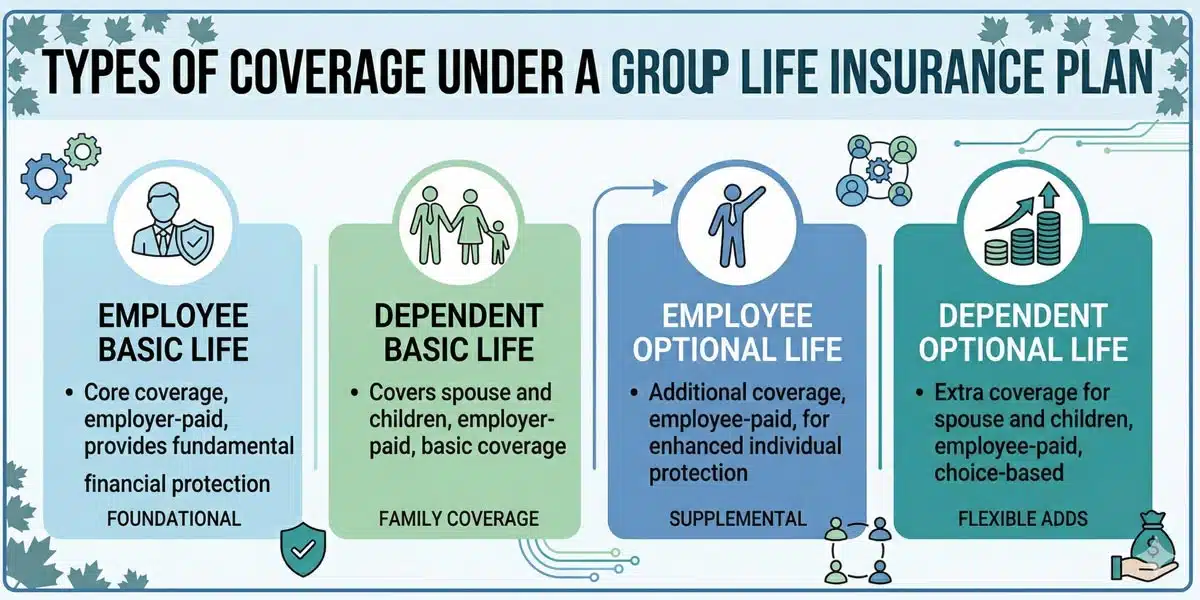
Group life insurance plans typically include employee basic life, dependent basic life, employee optional life, and dependent optional life. Each type is designed to serve a specific purpose and provide financial protection for employees and their families.
Employee Basic Life Insurance
Employee Basic Life Insurance is the most common component of a group life insurance plan and provides a lump sum death benefit to the employee’s designated beneficiary if they pass away while covered.
Coverage is typically available with two options. Employers typically structure this benefit either as a flat dollar amount or as a multiple of the employee’s salary.
Employee Optional Life Insurance
For employees who find that the basic coverage isn’t enough for their needs (e.g., to cover a mortgage), Employee Optional Life Insurance allows them to purchase additional protection for themselves at their own expense.
The main benefit is access to group rates, which are typically much lower than the rates an individual would find on the open market. Premiums are 100% employee-funded through convenient payroll deductions.
Dependent Basic Life Insurance
Dependent Basic Life Insurance covers the employee’s spouse and eligible dependent children under a separate, smaller benefit. Dependent Life plans provide coverage in flat amounts only, and coverage for the spouse is generally higher than that available for children.
Dependent Optional Life Insurance
This layer allows an employee to purchase additional life insurance for their spouse and, in some cases, children. This is crucial for families where the loss of a spouse’s income or their contribution to the household (e.g., as a stay-at-home parent) would cause significant financial strain.This coverage is entirely employee-paid. The employee can purchase it in units (e.g., units of $10,000) up to a plan maximum.
How Coverage Amounts Are Determined
When setting up a group life insurance plan, the employer decides how the death benefit for each employee will be calculated. This is done using one of two primary methods: a flat benefit schedule or an earnings-based schedule.
- A flat benefit schedule is the simplest approach. Every employee within a specific group, or “class,” receives the same fixed dollar amount of coverage, regardless of their salary.
- An earnings-based schedule ties the coverage amount directly to an employee’s income, calculating it as a multiple of their annual earnings.
The table below shows the difference between flat benefit schedules and earnings-based schedules, including how they work and examples:
| Schedule Type | How It Works | Typical Example |
| Flat Benefit | All members of an employee class receive the same fixed dollar amount of coverage. | All employees receive $50,000 in coverage. |
| Earnings-Based | Coverage is calculated as a multiple of the employee’s annual earnings. | An employee earning $80,000 with a 2x salary schedule receives $160,000 in coverage. |
That said, employers aren’t limited to just one method for the entire company. They often use a class-based design to tailor benefits to different roles.
How Group Life Insurance Works in Canada
The way group life insurance works in Canada can be understood in four key stages. It begins with the plan setup and administration, where the employer purchases and manages the master policy. Next comes employee enrollment, a process made simple by automatic approval up to certain coverage limits. The employee’s most critical step is designating a beneficiary to receive the funds. Finally, the entire system culminates in the payout process, where the named beneficiary receives a lump-sum payment after a claim is approved.

Plan Setup and Administration
The foundation of a group plan is that the employer is the policyholder. They hold the master contract with the insurance company and make all the key decisions, including which insurer to use, what the coverage levels will be, and how the costs are shared. While employees don’t own the policy themselves, they each receive a certificate of insurance that confirms their specific coverage under the group plan.
Premiums can be handled in one of three ways:
- Employer-Paid: The company covers the full cost.
- Employee-Paid: The employee pays the full cost, usually for optional or extra coverage.
- Cost-Shared: The employer and employee split the cost, which is the most common setup for basic coverage.
Any portion owed by the employee is conveniently paid through automatic payroll deductions. A major advantage of this group structure is that the rates are significantly lower than individual insurance. Because the insurer’s risk is spread across the entire employee group, the cost is much more manageable.
Tax Implications: When an employer pays your insurance premiums, it is usually considered a taxable benefit for you. However, the amount that shows up on your T4 slip isn’t always the exact premium your employer paid. For certain benefits, like group life insurance, the Canada Revenue Agency (CRA) uses a specific formula to calculate the value of the benefit. This final calculated amount is what gets reported as part of your income. For the employer, these payments are generally a tax-deductible business expense (Source).
Employee Enrollment and Coverage Limits
When an employee becomes eligible for benefits, usually after a short probationary period, they are enrolled in the group life insurance plan. As long as an employee enrolls within the specified window (typically 30-90 days after becoming eligible), they can get a substantial amount of coverage without having to answer medical questions or undergo an exam.
The Non-Evidence Maximum (NEM)
This easy enrollment is possible because of a feature called the Non-Evidence Maximum (NEM). The NEM is the highest amount of coverage an employee can automatically receive without having to provide “evidence of insurability” (proof of good health).
- If an employee’s coverage amount (often based on salary) is at or below the NEM, they are automatically approved.
- If a salary increase pushes an employee’s potential coverage above the NEM, they will still automatically receive the amount up to the NEM. For the excess amount, the insurance company will invite the employee to apply by completing a medical questionnaire. Approval for this extra coverage is not guaranteed.
The NEM amount is set by the insurer and depends on factors like the size of the company and its overall risk profile. Generally, larger companies have higher NEMs.
According to specialist group brokers, most Canadian insurers require a minimum of about five employees to be eligible for a group benefit plan, and the guaranteed NEM for life insurance in a 5–9-person firm could be as much as $150,000, with LTD NEM around $2,000/month (Source). As small employers grow in headcount, they become eligible for increases to the NEM levels for both Life and LTD coverage (Source).
The table below summarizes the typical NEM ranges observed in the Canadian market across the major group carriers. These figures are general benchmarks, and the final number depends on industry, claims history, and underwriting assessment:
| Group size (lives) | Typical Life NEM | Typical LTD NEM (monthly) |
| 5 – 9 | $50,000 – $150,000 | $1,500 – $2,000 |
| 10 – 24 | $100,000 – $200,000 | $2,000 – $3,500 |
| 25 – 49 | $150,000 – $250,000 | $3,500 – $5,000 |
| 50 – 99 | $200,000 – $350,000 | $5,000 – $7,500 |
| 100 – 499 | $300,000 – $500,000 | $7,500 – $12,000 |
| 500+ | $500,000 and above | $12,000 and above |
Because the NEM determines how much coverage an employee can get without medical underwriting, it also has an important impact on timing. The table below offers a simple decision framework so you can decide when to apply for more workplace coverage and when to supplement it with an individual policy:
| Your Situation | Recommended Action |
| You are young, healthy, and new to a company | Apply for any available optional coverage above the NEM during initial enrollment, when some plans offer expanded evidence-free amounts for new hires. |
| Your salary is approaching the NEM | Request optional coverage before a promotion pushes your coverage above the NEM and triggers medical underwriting. |
| You have been declined for excess coverage above the NEM | Secure the additional coverage you need through an individual term life policy, where you control the application and can shop among multiple insurers |
| You are healthy and well under the NEM | This is still the time to lock in an individual policy at your lowest-ever premiums, you may not always be this healthy. |
Table showing how to use the NEM strategically based on your coverage needs and health.
The NEM underscores why group life insurance should not be an employee’s only protection. Because the NEM caps the amount of guaranteed coverage, employees who need protection beyond that limit should secure an individual policy while they are healthy and fully insurable.
Separate from the NEM, every group plan also has an overall maximum benefit. This is the absolute highest amount of coverage an employee can have under the plan, regardless of their salary. No employee’s coverage can exceed this pre-defined ceiling.
Designating Beneficiaries
A critical step for the employee is to name a beneficiary, the person or people who will receive the insurance payout. Employees typically name a primary beneficiary and a contingent (or secondary) beneficiary, who would receive the funds if the primary beneficiary is unable to.
While filling out the form is simple, the legal rules behind it are surprisingly complex and are not the same across Canada. Things like whether a designation can be changed, what happens after a divorce, how to handle funds for a minor child, and whether creditors can access the money all affect who gets paid. The biggest source of confusion comes from the legal differences between Quebec and the rest of Canada (the “common law” provinces like Ontario, BC, and Alberta):
Revocable vs. Irrevocable Designations
When you name a beneficiary, the choice is either revocable (you can change it anytime) or irrevocable (you need the beneficiary’s written permission to change it). The rule depends on where you live:
- In All Provinces (Except Quebec): Beneficiary designations are revocable by default. You retain full control to update your beneficiary by submitting a new form. An irrevocable designation must be an explicit choice.
- In Quebec: The rule is reversed for spousal beneficiaries. A designation naming your married or civil union spouse is irrevocable by default. To maintain the flexibility to change it later, you must actively select the revocable option on the form. This default does not apply to common-law partners.
Actionable Takeaway: If you live in Quebec and are naming your spouse, pay close attention to the form. You must actively check a box to make the designation revocable and retain the flexibility to change it later.
The Impact of Divorce on Beneficiary Designations
The legal effect of divorce on a beneficiary designation differs between Quebec and the common law provinces:
- In All Provinces (Except Quebec): Divorce does not automatically remove your ex-spouse as your beneficiary. Even if your separation agreement says you’ve settled all claims, courts have consistently ruled that the beneficiary form is what matters. If you don’t update it, your ex-spouse will receive the payout, regardless of your intentions.
- In Quebec: Divorce automatically revokes the beneficiary designation for your former spouse by law. While this prevents an unintended payout to your ex, it creates a new problem: your policy now has no beneficiary. The money will go to your estate, where it can be delayed by probate and become exposed to creditors.
The table below highlights how beneficiary designations are affected by divorce in Quebec compared to the common law provinces:
| Scenario | Quebec | Ontario, BC, Alberta, etc. |
| Upon Divorce | Spousal designation is automatically cancelled. | Spousal designation remains in effect. |
| Required Action | Name a new beneficiary immediately. | Manually update the form to remove the ex-spouse. |
| Consequence of Inaction | Proceeds are paid to your estate. | Proceeds are paid to your ex-spouse. |
Key Takeaway: Following a divorce, you must proactively update your beneficiary designation. Do not assume the legal proceedings have altered your insurance policy.
Designating Minor Children as Beneficiaries
Naming your children as beneficiaries is a loving gesture, but it requires care. A minor cannot legally receive and manage a large sum of money. Without proper planning, the funds can be tied up by the government until your child turns 18 or 19.
- In All Provinces (Except Quebec): A surviving parent is the guardian of a child’s person, but not automatically the guardian of their property. If a minor is to receive funds over a certain threshold (e.g., $35,000 in Ontario) and no trustee is named, the money must be paid into court.
- In Quebec: Parents are automatically the “tutors” of their child’s property. The surviving parent can manage the inheritance, with court oversight typically required only for sums exceeding $25,000.
The table below compares the roles of parents, trustees, and courts when a minor child is named as a group life insurance beneficiary:
| Issue | Ontario, BC, Alberta, etc. | Quebec |
| Parent’s Role | Must apply to be “guardian of property.” | Automatically serves as “tutor” of property. |
| If No Trustee is Named | Funds are managed by the court/public trustee. | The surviving parent manages the funds. |
| Recommended Action | Always name a trustee on the beneficiary form. | Consider if tutorship is sufficient for your needs. |
Universal Warning: Never designate a minor as an irrevocable beneficiary. As a minor cannot provide legal consent, the policy would be unchangeable until they reach the age of majority.
Beneficiary Designations and Creditor Protection
In all provinces, you get powerful creditor protection if you name a “preferred” family member or make any designation irrevocable. If you name your estate, however, all protection is lost, and creditors can claim the money.
- In All Provinces (Except Quebec): The protected class includes your spouse (including common-law partners in most provinces), child, grandchild, or parent.
- In Quebec: The protected class is broader, including all descendants (children, grandchildren) and ascendants (parents, grandparents). However, it only includes married or civil union spouses. A common-law partner is not part of the protected class and must be named as an irrevocable beneficiary to receive the same creditor protection.
The table below summarizes which beneficiaries qualify for creditor protection in Quebec and the common law provinces:
| Beneficiary | Common Law Provinces (ON, BC, AB, etc.) | Quebec |
| Spouse (Married) | Protected | Protected |
| Spouse (Common-Law) | Protected (in most provinces) | Not Protected (unless made irrevocable) |
| Child, Grandchild, Parent | Protected | Protected |
| Grandparent | Not Protected | Protected |
| Your Estate | Not Protected | Not Protected |
Actionable Takeaway: To ensure the money goes to your family and not your creditors, always name a specific person from the protected class. Avoid naming your estate.
The Payout Process
If an employee passes away while covered by the policy, the named beneficiary is responsible for filing a claim with the insurance company, a process often facilitated by the employer’s HR department. Once the claim is approved, the insurance provider pays the death benefit directly to the beneficiary.
While this death benefit is paid to a named beneficiary tax-free in most cases, it’s important to know that any interest earned on the payout before it is delivered may be considered taxable income.
Is Group Life Insurance Enough on Its Own?
For most Canadian employees with dependents, mortgages, or significant financial obligations, group life insurance alone is unlikely to provide sufficient coverage.
Start with the numbers most Canadian families are already living with. The median outstanding balance on all Canadian mortgages sat at $245,000 as of September 2024, according to the Bank of Canada’s loan-level data. That’s the midpoint across everyone, people who’ve been paying down their homes for years included. For people who took out a mortgage in 2024, the median balance was $344,000, and the median appraised home value for those newer mortgages was $600,000.
Additionally, by Q1 2025, total household credit market debt in Canada reached $3.07 trillion, including mortgages, car loans, credit cards, lines of credit, and other forms of borrowing (Source). TD Economics reported the household debt-to-income ratio climbed to 177.2% by the end of 2025, which just means the average Canadian household owes about $1.77 for every dollar of take-home pay (Source).
These numbers matter because the amount of coverage provided through a typical employer-sponsored group life insurance plan may not stretch very far for many families. Even plans offering one or two times an employee’s annual salary can fall short once mortgage balances, household debt, childcare costs, and long-term income replacement needs are taken into account.
This is due to three limitations: the coverage amount is often too low, the policy is not portable if you change jobs, and the benefit reduces and eventually terminates with age.
The following sections explain each of these limitations in more detail:
- The Coverage Amount is Too Low: A benefit of 1-2x salary might cover a few years of household expenses, but it rarely provides the long-term financial security a surviving family needs to maintain their standard of living, pay off a home, and fund future goals.
- The Coverage is Not Portable: Group life insurance is tied directly to the job. If an employee is laid off, changes careers, or takes a break from the workforce, their coverage ends. This creates a dangerous period of exposure, often when financial obligations are still high. An individual policy, by contrast, is owned by the person and remains in force regardless of their employment status.
- The Coverage Reduces and Terminates with Age: Most group plans are designed to automatically reduce coverage, often by 50%, when an employee turns 65. Shortly after, typically at age 70 or retirement, the coverage terminates completely. This happens at a stage in life when securing new, affordable individual coverage can become much more difficult due to age and potential health issues.
Decision Framework: Choosing the Right Path to Fill Your Coverage Gap
Not every employee needs the same solution. You need to first calculate how much coverage your family would actually need, subtract the protection and resources you already have, choose the strategy that best fits your situation, and review your coverage regularly as your life changes.
The decision framework below helps you identify which approach, or combination of approaches, is right for your specific situation:
Step 1: Calculate Your Coverage Need
The DIME method is a straightforward way to estimate how much total life insurance coverage your family would need if you were no longer here.
It works by adding together four major categories of financial obligation: Debt (excluding your mortgage), Income replacement needs, Mortgage balance, and future Education costs for your children, as shown in the table below:
| DIME Component | What to Include |
| D — Debt | All debts excluding mortgage: car loans, student loans, credit cards, lines of credit, personal loans |
| I — Income | Years of income replacement needed × annual after-tax income (typically 7–10 years) |
| M — Mortgage | Outstanding mortgage balance |
| E — Education | Estimated post-secondary costs per child (tuition, living expenses) |
Adding these four figures together gives you your Total Coverage Need. This is the amount your family would require to maintain financial stability, eliminate debt, keep the home, and fund your children’s futures.
Step 2: Subtract Your Existing Resources
Once you know your total need, reduce it by the resources your family already has access to. These typically include:
- Your current group life insurance benefit
- Existing individual life insurance policies
- Liquid savings or investments that are earmarked for your family
- Your spouse’s sustainable income (if applicable)
- Estimated CPP Survivor’s Benefit.
The sum of these resources is then subtracted from your Total Coverage Need (calculated in Step 1). The resulting figure is your Coverage Gap, which represents the amount of additional life insurance you should consider securing.
Step 3: Choose Your Strategy
Now that you understand the size of your coverage gap, you can choose the most appropriate strategy based on your financial situation, employment stability, and long-term needs. The table below outlines which strategy may be most suitable for different situations:
| Your Situation | Recommended Strategy |
| Gap is small (under $100,000), and you plan to stay with your employer long-term | Purchase optional or supplemental group coverage if available. This is the simplest, lowest-cost option. |
| Gap is moderate ($100,000–$500,000) and you may change jobs | Purchase an individual term life policy. This gives you portability and rate stability regardless of employment changes. |
| Gap is large (over $500,000) or you have complex needs | Combine supplemental group coverage with an individual term policy. Use the group plan for its low cost and the individual policy for the bulk of coverage to ensure portability and long-term protection. |
| You are self-employed or have no access to a group plan | An individual life insurance policy is your only option. Consider term insurance for affordability or permanent insurance if you have estate planning needs. |
| You are nearing retirement (age 55+) with minimal obligations | Reassess whether you still need life insurance at all. If obligations are low and savings are sufficient, your existing group coverage may be adequate for final expenses. |
Step 4: Review Annually
Life changes and major life events can significantly change the amount of protection your family requires. Events that often require a coverage review include: marriage or divorce, having a child, purchasing a home, salary increases or career changes, taking on new debt, and approaching retirement. So you should revisit this framework at least once a year, or any time a major life event occurs. This ensures your coverage continues to align with your real-life responsibilities and goals.
Who Needs More Than Group Life Insurance?
Whether you are single, married, raising children, supporting a household on one income, approaching retirement, or parenting alone, your life stage plays a major role in determining how much life insurance protection you may actually need. While group life insurance can provide an important financial foundation, the level of coverage that is sufficient for one person may be far too limited for another.
Here’s a practical guide to help you assess your situation and decide what’s right for you at every stage:
Single, No Dependents
For you, a basic group policy might be enough to cover final expenses and any small debts you have.
Your Practical Next Step: This is the best time to buy an individual term life insurance policy. Premiums will never be lower than when you are young and healthy, making it a brilliant financial move that locks in affordable protection for the future.
Married or Partnered, No Kids
The big question here is simple: Could one of you handle the mortgage and other major bills alone? If the answer is no, you have a coverage gap.
Your Practical Next Step: Secure a supplemental policy that, at a minimum, is large enough to pay off your mortgage. This ensures the surviving partner won’t have to sell their home while grieving.
Parents with Young Children
This is the stage where group life insurance is almost never enough. With children depending on you, your financial obligations, from daily living costs to future education, are at their peak. Many Canadian parents admit they aren’t sure if their family would be financially secure if they were gone.
Your Practical Next Step: An individual term policy is essential, not optional. It’s crucial to calculate your family’s full needs (considering debts, income replacement, mortgage, and education) and get a policy to cover the entire gap.
Households with a Stay-at-Home Parent
A stay-at-home parent provides essential services: childcare, household management, and more, that would cost $50,000 to $80,000 a year to replace. The small dependent life insurance offered in group plans (often just $5,000 to $25,000) doesn’t come close to covering this.
Your Practical Next Step: It is vital to have a separate individual policy on the stay-at-home parent that reflects the true cost of their contribution to the family.
Nearing Retirement (Ages 55-65)
Many are surprised to learn that their group coverage often shrinks or ends entirely at retirement (usually age 65). At the same time, more Canadians are carrying mortgages and other debts later in life. This creates a dangerous financial gap.
Your Practical Next Step: Secure an individual policy before you retire or your health changes. This ensures your partner won’t be burdened with debt when your work benefits disappear.
Single Parents
As a single parent, you are your family’s sole provider. There is no second income to act as a safety net, making an adequate life insurance policy an absolute necessity.
Your Practical Next Step: Protecting your children against financial hardship is your top priority. Calculate your full needs with a special focus on income replacement and future childcare costs, and secure a policy to fill that gap immediately.
Before choosing coverage, review Group Life Insurance vs Individual Life Insurance to understand which option best matches your family’s long-term financial needs.
Advantages and Disadvantages of Group Life Insurance
Group life insurance offers a compelling package of employee benefits, but these come with significant trade-offs that employees must understand.
The primary advantages of group life insurance center on its low cost, convenient enrollment without a medical exam, and simple payroll deductions, making it an exceptionally easy way to secure baseline protection.
- Low cost – Group rates are significantly lower than individual life insurance.
- Easy enrollment – No medical exam required. Coverage is guaranteed for eligible employees.
- Convenience – Premiums are automatically deducted from paychecks.
- Peace of mind – Employees have assurance their family will receive a death benefit.
- Tax benefits – Premiums paid by employers are tax-deductible business expenses.
Conversely, its disadvantages all stem from the employee’s lack of ownership, leading to limited coverage amounts, a lack of portability between jobs, and no control over the policy’s terms or future.
- Limited coverage – Typically 1-2 times annual salary, which may need to be improved.
- Not portable – Coverage ends if an employee leaves the job or the policy is cancelled, although some employees may be eligible for group life insurance conversion options that allow them to continue coverage on an individual basis.
- No cash value – Group term life insurance does not build equity like permanent life insurance.
- Loss of control – The employer decides policy terms, coverage changes, and cancellations.
- Conversion challenges – Converting to an individual policy can be expensive, and requirements vary by province.
Overall, group life insurance provides an affordable way for employers to offer essential life insurance protection to employees. But there are some limitations to consider. As a result, supplementing with individual life insurance may be recommended for some employees.
What Are Your Options When Group Life Insurance Ends?
When you leave your employer, your coverage ends. However, you don’t have to be left unprotected. Canadian insurance carriers provide a “conversion privilege,” which is your right to convert your group life insurance coverage into an individual policy within a strict timeframe, usually 31 days, without a medical exam. Missing this deadline may mean losing the opportunity to obtain individual coverage without medical underwriting.
The rules for conversion, portability, and coverage amounts vary by insurer. The table below summarizes the specific policies for Canada’s major group life insurance carriers so you can understand your options when your employment changes:
| Carrier | Min. Group Size | Conversion Window | Max. Convert Amount | Converts To | Portability Option? | Coverage Reduction Schedule |
| Canada Life | ~3 lives | 31 days (Source) | $200K (<65); $50K (65+) | 1-Year Term, Term-to-65, or permanent plans | Plan-dependent | ~50% at 65; terminates at 70 or retirement |
| Sun Life | ~3 lives | 31 days (life); 60 days (health) (Source) | $200K ($400K in QC) | 1-Year Term, Term-to-65, or Sun Lifetime Alternative | Choices platform | ~50% at 65; terminates at 70 or retirement |
| Manulife | Varies | 31 days (standard); 60 days (FollowMe Life) (Source) | $200K | FollowMe™ Life (term) or other standard products | FollowMe™ Health & Dental | ~50% at 65; terminates at 70 or retirement |
| Desjardins | ~3 lives | 31 days (life); 60 days (health) (Source) | Per policy/provincial law | Individual Life and Critical Illness policies | Health Track Insurance | ~50% at 65; terminates per plan |
| Equitable Life | ~3 lives | 31 days (Source) | Per policy | Standard level-premium life plans | Plan-dependent | ~50% at 65; terminates at 70 or retirement |
| Empire Life | 3 lives | 31 days (before age 65) | $200K | 1-Year Term, Term-to-65, or permanent plans | Plan-dependent | 50% at 65; reduces to $5K at 70; terminates at 75 or retirement |
| RBC Insurance | ~5 lives | 31 days (Source) | Per policy | Permanent life plans | Plan-dependent | ~50% at 65; terminates at 70 or retirement |
| Beneva | ~3 lives | 31 days | Per policy/provincial law | Standard conversion products | Plan-dependent | ~50% at 65; terminates at 70 or retirement |
Carrier Highlights and Key Policies
- Manulife: Offers the FollowMe brand as a dedicated product for employees leaving a group plan, giving them a 60-day window to apply for guaranteed acceptance on health and dental coverage.
- Sun Life: Uses the term “Guaranteed Issue” instead of NEM and offers the Choices platform as a comprehensive post-employment benefits option.
- Empire Life: Features a unique age reduction schedule where coverage reduces at age 65, again to a flat $5,000 at age 70, and finally terminates at age 75 or retirement.
Please note that actual conversion limits, eligibility requirements, and available products may vary by policy, province, age, and insurer. Always consult your benefits booklet or insurer for details.
FAQ about Group Life Insurance
Who pays the group life insurance premiums?
This can work in a few different ways. Sometimes the employer covers the entire cost for basic coverage. Other times, the cost is shared between you and the employer. If you choose to add extra, optional coverage, you will typically pay for that portion yourself.
How do I qualify for group life insurance?
Eligibility is tied to your job. Usually, you need to be an active, permanent employee (either full-time or part-time, depending on the plan) and have passed any initial waiting or probationary period your company has.
What is the group life insurance coverage amount?
Coverage amounts vary, but a common formula for basic coverage is a multiple of your annual salary, like one or two times your pay. There is always a maximum limit, and the specific details will be outlined in your employee benefits booklet.
Can I keep my group life coverage if I leave my job?
Coverage is tied to your employment and typically terminates when you leave. However, you are usually given options to continue your life insurance.
The most common is the “conversion privilege,” which allows you to convert the group policy into a new, individual policy within a set period (often 31 days) without needing a medical exam. Some plans may also offer a “portability” option, which lets you take your existing coverage with you by paying the premiums directly. Because these options are subject to strict deadlines, it is essential to review your benefits guide or speak with your plan administrator to understand the specific provisions available to you.
Do I need a medical exam to get group life insurance?
Typically, no. For the standard coverage that comes with your group plan, you’re typically approved automatically without any medical questions asked. However, if you decide to enroll late or if you apply for coverage above that guaranteed amount, the insurer may require you to provide more health information.