



After years of contributing to the Canada Pension Plan (CPP) through every paycheck, you have earned the right to a secure retirement. While the CPP offers various types of support, the retirement pension is the one most Canadians rely on to fund their golden years.
However, many Canadians do not realize that CPP retirement pensions are not issued automatically; you must proactively apply to start receiving your benefits. There are two primary methods for applying: an online application or a mail-in paper form.
Before sitting down to apply, make sure to gather all the necessary documents. At a minimum, you will need your Social Insurance Number (SIN) and your banking information for direct deposit.
To ensure you receive your full entitlement without delay, this guide will detail what you need to apply for Canada Pension Plan benefits and choose the application method that best fits your needs.
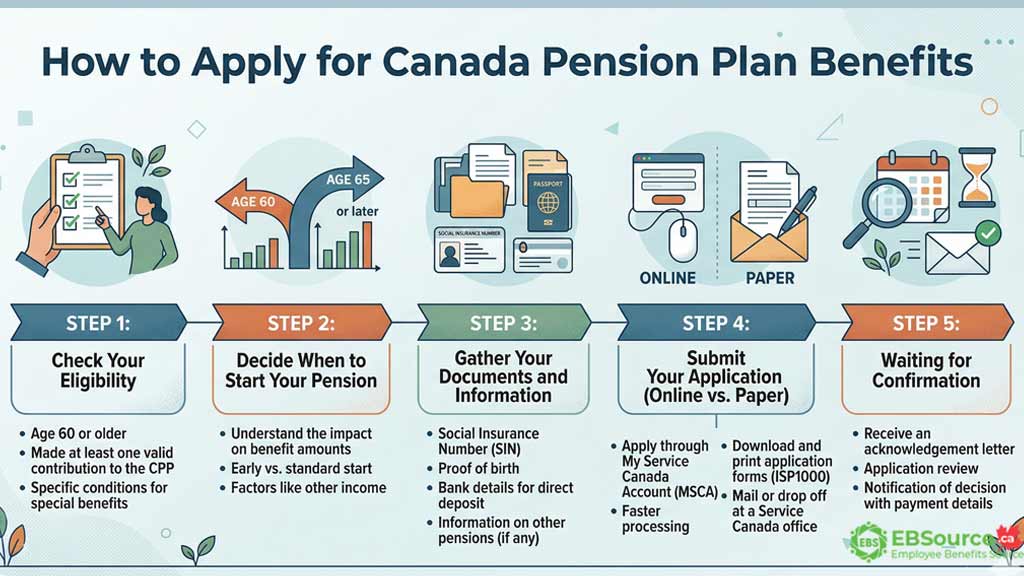
CPP Retirement Pension Application Methods: Online vs. Paper
You can apply for the CPP retirement pension online for the fastest processing or by mailing a paper form. Below is how the two methods work:
Option 1: Applying Online via My Service Canada Account (MSCA)
The online application is the fastest and most convenient method, which typically processes within 28 days.
How to apply:
- Sign in to My Service Canada Account (MSCA)
- Click “Apply for Canada Pension Plan Retirement Pension”
- Complete all sections of the online application form and submit
If Service Canada needs extra information, they will tell you what to provide and how to submit it.
Option 2: Applying by Paper with Form ISP-1000
If you prefer to apply on paper or don’t have an online account, you can also apply by mail; processing takes up to 120 days.
How to apply:
- Download the “Application for a Canada Pension Plan Retirement Pension (ISP-1000)” or call 1-800-277-9914 to have a copy mailed to you.
- Fill out all sections clearly. Be sure to sign the declaration in Section E, as an unsigned form will be returned.
- Mail the completed application to the Service Canada office for your province or territory, or drop it off in person at a Service Canada Centre.
Important Note: You must use a paper application instead of applying online if any of these apply:
- You live outside Canada
- A third party (for example, a power of attorney or trustee) manages your CPP account.
- Your CPP disability benefit ended before you turned 65, or you were denied a disability benefit in the past
- Certain CPP children’s benefit payment-history situations apply
Either way, be sure to submit any required supporting documents to avoid processing delays. You can apply up to 12 months before your chosen start month. Applying in advance will provide a safe buffer for processing and ensure your payments begin on time.
What Documents and Information Are Needed to Apply for CPP Benefits?
You need to gather essential documents before starting your CPP application. Required information varies based on your situation and chosen application method. If you have everything ready to go, you can streamline the process and prevent delays.
Everyone who applies for CPP must provide these fundamental details:
- Your Social Insurance Number (SIN)
- Banking information for direct deposit of payments
- Current mailing address
- Contact information
In addition, different life circumstances may require you to provide additional paperwork:
- If you were not born in Canada or did not work here as a temporary resident, have your immigration documents (such as a Permanent Resident Card or work permit) available.
- If you lived or worked outside Canada, provide the names of the countries, your social security or insurance number from each of those countries, and the dates you started and stopped working there.
- If you are divorced or legally separated, you may need your separation agreement or divorce decree to apply for a splitting of CPP credits.
- If you are applying for Child Rearing Provision claims, you will need to provide for each child: their full name and date of birth, their SIN, and proof of date of entry if born outside Canada.
What Happens After You Submit Your CPP Application?
Once you submit your CPP retirement pension application, Service Canada reviews your contribution record, verifies your eligibility, confirms your chosen start date, and calculates your monthly pension amount. The entire process takes approximately 28 days for online submissions or up to 120 days for paper applications.
You can check the status of your application by signing into your MSCA and selecting “View my status updates. When processing is complete, you will receive a formal decision letter by mail. If approved, it will state your monthly pension amount and your first payment date.
Payments are made near the end of each month. If you signed up for direct deposit, the funds will appear in your account. Otherwise, a cheque will be mailed.
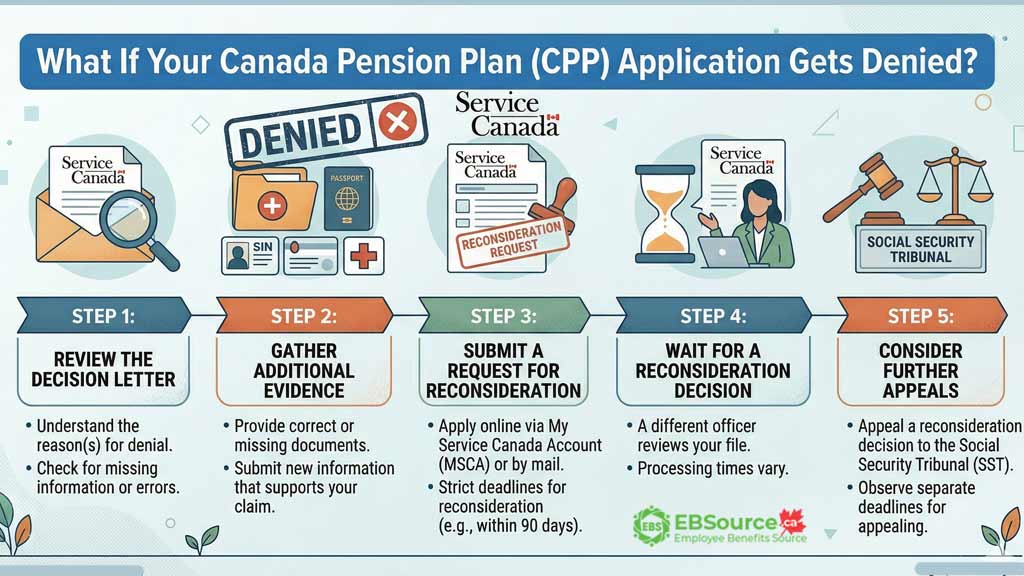
What If Your CPP Application Gets Denied?
Your CPP retirement pension application may be denied for eligibility reasons or due to insufficient information. To clarify, Service Canada provides written explanations with denial letters. Common denial reasons may include incomplete work history verification, missing contribution years, documentation errors, and identity verification failures.
If your application is denied or you believe the pension amount is incorrect, you can ask Service Canada to reconsider within 90 days of receiving your decision letter. If you still disagree after the reconsideration, you can appeal to the General Division of the Social Security Tribunal (SST). The SST generally requires your appeal within 90 days after you receive the reconsideration decision.
Where Can You Get Help With Your CPP Application?
Service Canada offices nationwide provide free assistance with CPP applications. You can book appointments for complex situations or language barriers. Staff can help you with forms, documentation, and system navigation.
Phone support operates Monday through Friday at 1-800-277-9914. Have your SIN ready before you call. Wait times vary seasonally, with shorter queues in the early mornings.
Community organizations also offer application assistance for seniors. Libraries, senior centers, and immigrant services often host CPP information sessions. These resources are particularly helpful for those who are uncomfortable with technology.
While financial advisors can’t submit your application, they can help you with timing decisions and tax planning. Fee-only advisors provide unbiased guidance without product sales pressure.
FAQs on How to Apply for Canada Pension Plan Benefits
Can I apply for CPP retirement pension if I've only worked in Canada for a few years?
Yes, you can apply for CPP with just one valid contribution. However, your benefit amount will be proportionally small. The system calculates benefits based on your total contribution years and amounts. International social security agreements may help if you've worked in other countries.
What happens to my CPP if I continue working after age 65?
You can work while receiving CPP after age 65. From ages 65 to 70, you can choose whether to continue contributing. These additional contributions create Post-Retirement Benefits (PRB), increasing your monthly pension. Before age 65, you must continue contributing if working while receiving CPP.
How does divorce affect my application?
Divorce allows CPP credit splitting for the years you were married. Both ex-spouses can apply to divide pension credits earned during marriage. This doesn't require your ex-spouse's consent in most provinces. Include your divorce decree when applying and complete the credit split section.
Why is the CPP application not available in languages other than English and French?
CPP applications are available only in Canada's official languages as required by federal law. However, Service Canada provides interpretation services at their offices. You can bring a trusted translator when visiting in person, or request telephone interpretation services when calling.
Applying for the Canada Pension Plan requires careful planning and timing to maximize your retirement benefits. By following the steps outlined above, you can smoothly transition into collecting the CPP benefits you’ve earned over your Canadian working life. Remember that CPP forms one piece of retirement income. Combine with OAS, employer pensions, and personal savings for complete security.