


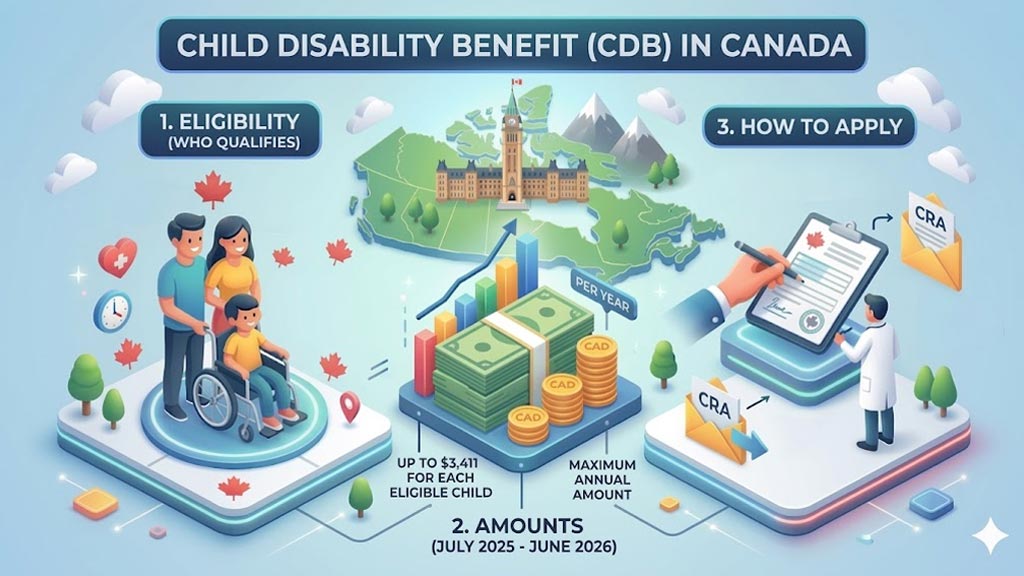
The Child Disability Benefit (CDB) is a tax-free monthly government benefit for families caring for a child under 18 with a severe and prolonged physical or mental impairment.
To qualify for benefits, the caregiver must receive the Canada Child Benefit (CCB), and the child must be approved for the Disability Tax Credit (DTC). For the benefit year from July 2025 to June 2026, families can get up to $3,411 for each eligible child. This amount may be lower depending on the family’s adjusted net income.
Our article covers the key details you need to know about the Child Disability Benefit, including who qualifies, how much you receive and how to apply.
What is the Child Disability Benefit?
The Child Disability Benefit CDB is a tax-exempt monthly benefit managed by the Canada Revenue Agency (CRA). It provides financial assistance to families who have a child living with serious and long-term disabilities and is under the age of 18.
The CDB is intended to assist with the additional costs that frequently arise when raising a child with a disability. Such costs can involve therapy, medical apparatus, medication, and education.
When paired with other benefits, such as the Disability Tax Credit (DTC), it can go a long way to covering the high monthly costs of long-term care.
Who Qualifies for the Child Disability Benefit?
To qualify for the Child Disability Benefit, families must meet two primary requirements: eligibility for the Canada Child Benefit (CCB) and the child’s eligibility for the Disability Tax Credit (DTC).
Canada Child Benefit (CCB) Requirement
The CDB is paid as a supplement to the CCB, so the caregiver must first qualify for that benefit. The core CCB requirements include:
- Reside with a child who is under 18 years of age.
- Be primarily responsible for the child’s care and upbringing.
- Be a resident of Canada for tax purposes.
- You or your spouse must be a Canadian citizen, permanent resident, or protected person.
If you are already receiving the CCB, this requirement is satisfied.
Disability Tax Credit (DTC) Requirement
The child must also be approved for the DTC. Eligibility requires a medical practitioner to certify, on Form T2201, Disability Tax Credit Certificate, that the child has a severe and prolonged impairment in physical or mental functions. The CRA must then review and approve the completed form.
You can submit Form T2201 to the CRA at any time during the year. Once both the CCB and DTC conditions are satisfied, the CDB is added automatically to your monthly CCB payment with no separate application required.
How Much Can You Receive?
For the July 2025 to June 2026 benefit year, eligible families can receive up to $3,411 per child ($284.25 per month).
CDB payments are calculated using the number of eligible children in the household and your adjusted family net income (AFNI). Every July, the CRA recalculates payments based on your AFNI from the previous year’s tax return.
For the current benefit year, July 2025 to June 2026, payments are based on your adjusted family net income from your 2024 tax return. Each qualifying child can generate up to the full $284.25 monthly amount, subject to income-based reductions described below.
The benefit starts being reduced when the adjusted family net income is greater than $81,222. The reduction rate depends on the number of eligible children:
- One eligible child: reduction of 3.2% of AFNI above $81,222.
- Two or more eligible children: reduction of 5.7% of AFNI above $81,222.
For example, a family with one eligible child and an annual family income of $91,222 will have their annual Child Development Benefit (CDB) reduced by $320. This is 3.2% of the $10,000 that is above the income threshold. As a result, their yearly CDB will drop from $3,411 to $3,091. Families with an income of $81,222 or less will receive the full amount.
You can use the CRA’s child and family benefits calculator to estimate your specific payment based on your household’s circumstances.
How to Apply for the Child Disability Benefit
Most families do not need to submit a separate application. The CDB is added automatically once both the CCB and DTC requirements are met.
If you are already receiving the Canada Child Benefit and your child has been approved for the Disability Tax Credit, you do not need to apply for the CDB. The CRA includes it with your existing CCB payment automatically.
If your child has not yet been approved for the DTC or if you are not receiving the CCB, both prerequisites must be completed before CDB payments can begin.
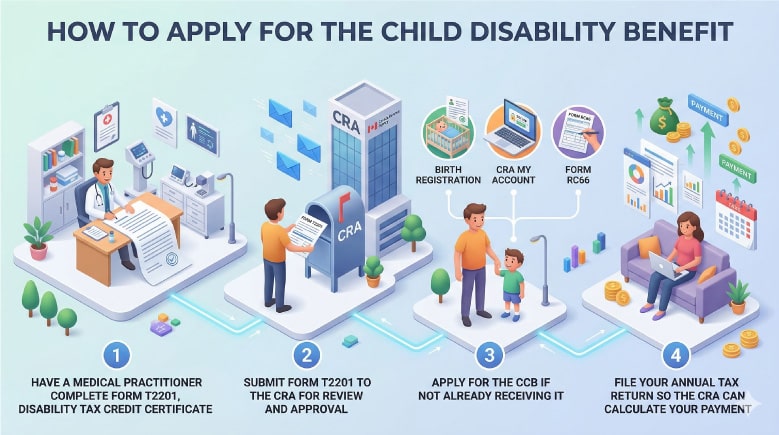
- Have a medical practitioner complete Form T2201, Disability Tax Credit Certificate.
- Submit Form T2201 to the CRA for review and approval.
- Apply for the CCB if not already receiving it (birth registration, CRA My Account, or Form RC66).
- File your annual tax return so the CRA can calculate your payment.
Once the CRA approves the form and your CCB eligibility is confirmed, CDB payments begin.
When you get your CDB for the first time, the CRA automatically figures out your payments for the current year and the two previous years. The benefit year goes from July to June, so this calculation can include payments from almost three years, depending on when you apply.
For benefit years before that automatic window, you can send a written request to your tax centre to have the CRA assess those earlier periods. Families who delayed applying may still recover a significant portion of the benefit they were entitled to, though it requires a proactive step beyond the standard process.
How to Keep Receiving the CDB
CDB payments continue for as long as the caregiver remains eligible for the CCB and the child remains eligible for the DTC.
Timely tax filing is the single most important ongoing step. Both the caregiver and their spouse or common-law partner must file taxes on time every year, even if there was no income at all or the income is tax-exempt. The CRA uses both returns to determine the adjusted family net income for the CDB calculation, so a missing return from either partner will delay or stop payments until it is filed.
Families must also keep personal information updated with the CRA. Changes in address, marital status, or custody arrangements should be reported promptly because these factors directly affect the AFNI used in the calculation.
If you are leaving an abusive or violent situation, the CRA has processes to help you continue receiving benefits without putting yourself or your family in danger.
How does the Child Disability Benefit compare to the Disability Tax Credit?
Although the Child Disability Benefit (CDB) and the Disability Tax Credit (DTC) are linked through eligibility, they differ across eight key features that affect how families receive and use the support. These include the type of benefit, maximum value, payment method, income testing, eligibility requirements, transferability, timing of payment and overall purpose.
See the table below for a comparison of their differences:
| Feature | Child Disability Benefit (CDB) | Disability Tax Credit (DTC) |
| Type | Monthly cash payment | Non-refundable tax credit |
| Maximum Value | $3,411/year (2025-26) | Base amount: $10,138 (2025); children under 18 can get an additional supplement up to $5,914 |
| Payment Method | Direct deposit with CCB | Applied to the tax return to reduce taxes owed |
| Income Testing | Reduced above $81,222 AFNI | No income test |
| Eligibility | Must qualify for CCB, and the child must be approved for DTC | Form T2201 approved by CRA |
| Transferable | No | Yes, the unused portion can be transferred to the supporting person |
| When Received | Monthly throughout the year | At tax filing or via payroll |
| Purpose | Ongoing expense support | Reduce income tax burden |
While they work together, the CDB provides cash in hand to pay bills and expenses. The DTC lowers the overall tax burden for caregivers. A child can qualify for both benefits simultaneously.
In conclusion, the Child Disability Benefit (CDB) is important for Canadian families with children who have severe and long-lasting disabilities. It provides tax-free monthly payments to help cover ongoing care costs. The CDB works together with the Disability Tax Credit (DTC) to offer better financial support. With the right assistance, children with disabilities can grow and succeed just like their peers.
FAQs about Child Disability Benefit in Canada
Is the Child Disability Benefit retroactive?
Yes, first-time CDB recipients can receive up to 2 years of retroactive payments automatically. Ongoing recipients have payments recalculated annually.
Do families need to reapply for the Child Disability Benefit each year?
No. As long as you remain eligible and file taxes annually, payments will continue automatically without needing to reapply.
Can other caregivers, like grandparents, receive the Child Disability Benefit?
Yes. As long as the caregiver meets eligibility criteria, the CDB can be paid to grandparents, foster parents, and other legal guardians caring for an eligible child.
Are CDB payments increased each year?
Yes, CDB payment amounts are indexed annually based on changes to the cost of living. Maximum payment amounts typically increase slightly each July.
Does ADHD qualify for the Child Disability Benefit?
Yes, severe ADHD that markedly restricts daily functioning and meets Disability Tax Credit criteria can qualify a child for the CDB. Supporting medical evidence is required.
Can the CDB be claimed for a dependent child over age 18?
No, the child must be under 18 years old to qualify for the CDB. Other disability tax benefits may be available for dependent children 18 and over.