



Manulife stands as one of Canada’s largest group benefits providers, offering small business solutions for 2 to 50 employees and customizable plans for organizations with more than 50 members.
The plans are built around coverage flexibility, offering Canadian employers a customizable structure where core health, dental and disability benefits can be tailored across multiple employee classes and coverage tiers.
On the cost efficiency side, the plan provides spending accounts, scalable participation models, and plan design options that give employers levers to manage monthly premiums.
Manulife is known for its online claims platform, mobile app, and digital tools for managing policies. At the same time, some plan members and employers report concerns related to claim adjudication and customer service.
Is Manulife’s Coverage Flexible Enough for Both SMEs and Large Corporations?
Manulife provides flexible group benefits for small businesses and larger organizations. Employers can choose from essential health and dental benefits, add optional coverage, and customize plan features to meet their workforce needs and budget. The level of customization depends on the type of plan and group size.
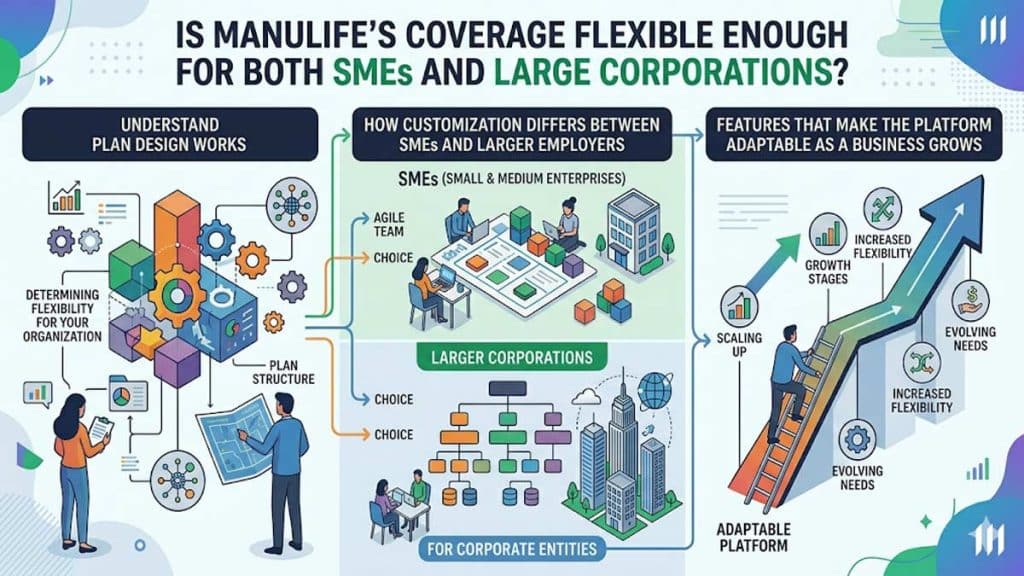
To determine whether Manulife provides enough flexibility for your organization, it is important to understand how its plan design works, how customization differs between SMEs and larger employers, and what features make the platform adaptable as a business grows.
How Manulife’s Flexible Plan Design Works
Depending on the group size and plan tier selected, Manulife structures its benefits through a combination of foundational coverage and scalable additions.
As shown in the table below, employers can customize core benefits, add optional coverage, incorporate spending accounts, and choose different cost-sharing arrangements based on their workforce needs and budget.
| Coverage Type | Available Options |
| Core Benefits | Extended Health Care, Prescription Drugs, Dental Care, Disability Coverage |
| Optional Benefits | Enhanced dental coverage, higher reimbursement levels, and additional disability protection |
| Spending Accounts | Health Spending Accounts (HSA) and Lifestyle Spending Accounts (LSA) |
| Cost-Sharing Options | Employer-paid, employee-paid, or shared-cost arrangements |
This modular structure lets employers choose the benefits that are most important to their employees while keeping control of overall plan costs.
Flexibility for Small Businesses vs. Larger Organizations
The level of customization in a Manulife group plan depends on the size of the employer. To manage costs and simplify administration, Manulife offers two types of plans based on the needs of different organizations: Small Business Plans and Customizable Plans.
- Small Business Plans (2 to 50 employees) use a more standardized structure with fewer customization options and simpler administration requirements. These plans provide health and dental coverage options within a simplified framework that can be adapted to the needs of smaller businesses.
- Customizable Plans (50+ plan members) offer more design flexibility. This allows organizations to tailor their benefits packages with additional coverage options, flexible plan features, and other customization choices available under the plan.
This structure helps growing companies expand their benefits over time without needing to replace the entire program as their workforce needs change.
Source: https://www.manulife.ca/business/group-benefits/plans-and-coverage.html
What Makes Manulife Particularly Flexible?
One of Manulife’s biggest strengths is that there is no true “standard” plan. Two businesses of similar size can have significantly different benefit structures depending on the coverages, reimbursement levels, and spending accounts they choose.
This flexibility helps employers avoid paying for benefits that their workers probably won’t use. It ensures that important areas of coverage get enough funding. It also allows growing companies to improve benefits gradually as their hiring needs and employee expectations change.
Example: Consider two businesses with 30 employees that both purchase a group benefits plan from Manulife.
The first company chooses richer extended health coverage with higher reimbursement levels for paramedical services and a comprehensive long-term disability benefit.
The second company selects more moderate health coverage but allocates part of its budget to a Health Care Spending Account that gives employees additional flexibility in how benefits dollars are used.
Both employers are working with the same carrier, yet employees may have very different experiences because the plan design, reimbursement structure, and funding priorities are not the same.
EBSource Advisor Note: Before choosing a final plan design, ask for different coverage options and pricing examples. Comparing various levels of coverage, disability protection, and spending account choices can help you find the most cost-effective plan for your workforce.
How Much Do Manulife Group Benefits Cost
Manulife does not publish standard group benefits pricing because premiums are calculated based on each employer’s plan design and claims risk. As a result, there is no universal monthly rate that applies to all businesses.
Although pricing varies from one organization to another, employers can better assess the long-term value of a Manulife plan by understanding what drives renewal costs and which plan design features can help manage future premium increases.
What Affects Renewal Costs?
After the initial policy period, Manulife reassesses premiums based on factors such as healthcare trend inflation, claims utilization, and the plan’s Target Loss Ratio (TLR). The TLR represents the percentage of premiums that Manulife expects to pay back in claims.
For smaller employer plans, Manulife usually uses pooled risk structures to keep rates stable. For larger groups, the plans depend on specific TLR benchmarks that change based on the size of the group and the design of the plan.
Prescription drug claims are often the largest contributor to rising benefits costs. If overall claims activity exceeds the expected threshold, employers may experience significant renewal increases to bring the plan back in line with target profitability. Even groups with relatively low claims activity can still see annual premium increases as healthcare costs continue to rise across Canada.
How Can Employers Control Costs?
One of Manulife’s advantages is the number of plan design tools available to help employers manage long-term benefits spending.
Manulife structures its plan design around Health by Design, a proactive care model that focuses on prevention and early intervention rather than just paying claims. Here are the primary tools used to achieve this: My Drug Plan & Specialty Drug Care (SDC), Health Care Spending Accounts (HCSA) & Lifestyle Spending Accounts (LSA), and Absence & Disability Management.
- My Drug Plan & Specialty Drug Care (SDC): These programs are designed to help manage prescription costs. My Drug Plan typically requires using generic drugs for common medications, while the SDC program focuses on case management and utilizing preferred providers to potentially lower the costs of expensive specialty medications on a voluntary member participation basis.
- Health Care Spending Accounts (HCSA) and Lifestyle Spending Accounts (LSA): These accounts provide employees with greater flexibility while allowing employers to establish defined contribution budgets rather than pre-funding coverage for services that may never be used.
- Absence and Disability Management: Manulife provides programs to help with managing employee absences, planning their return to work, and overseeing disability cases. These tools assist employers in tracking workforce health trends and managing costs related to disabilities more effectively.
Instead of trying to cover every category, employers can often get better long-term value by focusing their benefits spending on the services their employees are most likely to use.
How Good Is Manulife’s Digital Claims Experience?
Manulife’s digital claims experience is built around two platforms: the Manulife Mobile app and the Plan Member Secure Site.

For employers evaluating the member experience, the key considerations are whether employees can complete most benefits tasks without paper forms and whether the platform creates any recurring usability issues during claims submission and plan management.
What Can Members Do Through the App and Online Portal?
Manulife lets members complete most routine benefits tasks online, reducing the need for paper forms. With the Manulife Mobile app and Plan Member Secure Site, members can use standard self-service functions and access some valuable features:
- Direct Provider eClaims: Many healthcare providers can send claims directly to Manulife while you are receiving care. This means that employees only need to pay the part that is not covered, avoiding the need to wait for reimbursement.
- Smart Drug Lookup & Substitution: Members can check if their prescription drugs are covered and find cheaper generic options.
- Digital Benefits & Coordination: Access a wallet-ready digital benefits card and coordinate claims across secondary spousal plans.
- Standard Account Maintenance: Electronically submit health, dental, and paramedical claims, upload receipts, set up direct deposit, and track reimbursement progress.
The platform provides the core self-service functions most employees expect from a modern benefits provider, including online claims submission, direct deposit, digital benefits cards, drug coverage lookup, and coordination of benefits. Manulife states that health and dental claims are typically processed within up to five business days when all required documentation is provided.
Where Does the Digital Experience Fall Short?
While Manulife’s digital tools handle routine dental and pharmacy claims very well, the system can become clunky for more complex tasks. Employers should know that users may run into specific limits when handling complex claims.
These include a repetitive workflow for multiple receipts, strict security timeouts, limited policy details on phones, and slower processing times when manual reviews are needed.
Repetitive Workflow for Multiple Receipts
The app can only process one receipt at a time. If an employee has receipts from one clinic visit, they must go through the entire submission process for each receipt, which takes extra time for families with ongoing treatments.
Strict Security Timeouts
To protect private financial data, the app logs users out quickly after a short period of inactivity. If an employee switches to another app on their phone to look up a receipt or check provider details while filling out a claim, the app may reset, forcing them to log in again and restart the application from scratch.
Limited Policy Details on Mobile
The phone app is designed for quick tasks, like checking account balances and showing your digital benefits card.
However, if an employee wants to read the full contract or check specific rules and exclusions before booking a pricey specialist treatment, they cannot find that detailed information on their phone. Instead, they need to use the desktop website.
Slower Manual Review Timelines
When a claim is unusual or complicated, like coordinating with a spouse’s insurance plan or checking the status of a late application, the automated system cannot process it right away.
Instead, it is sent to a human staff member for review. This extra step takes longer, so employees will have to wait more days for their money compared to the usual instant approvals from the app.
Pro tip: Manulife’s digital system works well for simple claims, like direct-pay prescriptions and dental visits. For more complicated claims that require multiple documents or detailed checks, it’s better to use the mobile app to track the claim status instead of managing the entire process.
Why Do Some Manulife Claims Lead to Employee Frustration?
Based on member feedback, many frustrations arise when claim outcomes do not match employee expectations.
The most common areas of confusion involve paramedical reimbursement limits, brand-name drug coverage, prior authorization requirements, and dental co-insurance rules:
| The Plan Rule | What the Employee Expects | The Actual Outcome |
| 100% Paramedical Coverage | The entire massage clinic bill will be reimbursed. | Reimbursement is capped at Manulife’s internal Reasonable & Customary (R&C) limit. The employee pays the difference. |
| Prescription Drugs Covered | Their preferred brand-name drug is fully paid for. | Manulife only pays up to the cost of the cheapest generic equivalent. The employee pays the difference. |
| Doctor Recommends a Treatment | If a doctor prescribes it, the plan will automatically cover it. | High-cost treatments still require Prior Authorization and must meet strict eligibility criteria. |
| Dental Maximum | Major dental services are fully covered up to a fixed annual dollar amount (example: $1,500). | Co-insurance applies. If the plan covers 80% of basic services, the employee still pays 20% out of pocket on every visit until the $1,500 max is reached. |
To minimize benefits-related complaints and improve employee satisfaction, employers should communicate plan limitations proactively during onboarding and annual renewal periods rather than waiting until a claim is denied.
Proactively Explain Coverage Limits
Ask your broker to provide employees with a simple comparison between:
- Provincial dental and paramedical fee guides.
- Manulife’s current Reasonable & Customary limits.
This helps employees understand in advance which expenses may exceed plan reimbursement levels and require out-of-pocket payment.
Encourage Employees to Check Drug Coverage Before Filling Prescriptions
Employees should be encouraged to use Manulife’s drug lookup tools before visiting a pharmacy. These tools can help determine:
- Whether a medication requires Prior Authorization.
- Whether Generic Substitution rules apply.
- The expected reimbursement amount.
A quick verification beforehand can prevent unexpected costs and frustration at the pharmacy counter.
Establish a Clear Escalation Process
Employees should know exactly who to contact depending on the nature of the issue.
| Issue Type | Appropriate Contact |
| App errors, password resets, and login problems | Manulife Member Support |
| Denied claims or delays related to Prior Authorization | HR department to verify plan provisions and eligibility |
| Complex disputes, appeals, or formal complaints | Benefits Advisor or Corporate Broker |
Pro tip: Many claim disputes begin long before a claim is submitted. Organizations that proactively explain how coverage limits, reimbursement rules, and authorization requirements work can often reduce employee frustration and improve overall satisfaction with the benefits plan.
Is Manulife the Right Fit for Your Business?
Manulife works well for employers who want flexible plans, employee choice, and unique benefits. However, it might not be the best option for organizations that mainly focus on stable rates or low-maintenance administration.
To see if Manulife is right for your business, consider where it provides the most value, where other insurers might have an edge, and which types of organizations are likely to benefit from its offerings.
Where Manulife Delivers the Most Value
Manulife provides the most value when employers want more control over plan design, managing spending accounts, and handling benefits administration. Its key benefits include flexible employee class structures, integrated spending accounts, and the ability to combine multiple benefit services into one platform.
More Flexibility in Employee Benefit Classes
One of Manulife’s structural advantages is its ability to support multi-tiered employee benefits within a single contract, even for smaller workforces. While small business plans in the Canadian market traditionally favour simplified structures to ease administration, Manulife allows employers to establish sophisticated, tiered benefit setups to better match corporate hierarchies.
For example, a company can implement the following within a single plan:
- Executive team: 100% reimbursement with no deductible.
- Office employees: 80% reimbursement.
- Hourly employees: 70% reimbursement, with limits on paramedical services.
All of these employee classes can be administered under the same contract without requiring the company to move into the underwriting process typically reserved for larger employers.
Managing HSA and WSA Through One Platform
Manulife manages Health Spending Accounts (HSA) and Wellness Spending Accounts (WSA) on the same platform.
Employers should understand that these accounts have different tax rules. HSA funds are tax-free for employees to use for out-of-pocket medical expenses, except in Quebec. On the other hand, WSA/LSA reimbursements are taxable benefits and must be reported on the employee’s T4 slip. This system helps lower core plan costs while providing flexible benefits.
All-in-One Ecosystem Consolidation
For organizations wanting to offer an Employee Assistance Program (EAP) via LifeWorks/Workplace Advisor and virtual care via TELUS Health without managing 4 separate vendor invoices, Manulife aggregates these point solutions into a single monthly bill and a unified employee login.
Where Manulife May Not Be the Best Choice
Manulife offers a lot of flexibility, but some competitors might be better for employers who want easy administration or quicker help with complex claims. These differences are especially clear in workforce administration and claims servicing.
More Administration for High-Turnover Employers
Manulife’s Plan Administrator Portal is often viewed as relatively rigid compared to some competitors, particularly for employers with frequent workforce changes.
This can become a challenge for businesses operating in industries such as:
- Retail
- Hospitality and food services
- Construction
For these employers, timely enrollment and eligibility management are particularly important.
Many Manulife group plans require eligible employees to enroll within a specified period (commonly 31 days). If employees miss the enrollment deadline, they may be considered late applicants. They might need to show proof of insurability before they can access certain benefits.
Many group insurance plans follow a standard practice that can lead to confusion. Employees may expect immediate coverage but might not know about the enrollment requirements.
Service Delays When Claims Require Manual Review
Manulife mainly uses automated systems to process routine claims. However, if a claim needs extra documents, a review of benefits coordination, eligibility checks, or other special considerations, it will be sent for manual review.
This can lead to longer processing times than usual, which may vary based on the case’s complexity and the information needed for the review. Employers with many claims may sometimes face longer wait times for these more complicated cases.
Which Organizations Are the Best Fit for Manulife
Instead of generalized alignment, use this operational checklist to cross-reference your internal corporate capabilities against Manulife’s structural layout:
| If Your Business Reality Looks Like | Manulife’s Actual Fit | The Strategic Alternative |
| Micro-team (2-10 lives) prioritizing long-term rate stability over complex plan customization. | Conditional Fit. Manulife protects small businesses by pooling their claims together, but small groups remain sensitive to general healthcare inflation and pool-wide premium changes. | Work with an advisor to evaluate highly pooled industry block plans (such as the Chambers Plan) to lower individual group risk, though no plan can completely stop annual inflation updates. |
| Multi-tiered workforce requiring clear demarcation of executive vs. operational perks. | Strong Fit. Natively supports complex class designs on a single billing account. | Proceed with Manulife, but utilize an active broker to audit the provincial fee guide alignment annually. |
| High-turnover model without a dedicated, full-time HR administrator. | Adequate Fit. Administrative lag will lead to “Late Applicant” penalties and enrollment errors. | Look into Beneva or a specialized third-party administrator (TPA) that automates enrollment feeds. |
| Demands high-touch human review for complex or specialized health claims. | Conditional Fit. The system is optimized for instant, automated dental/drug claims. Manual reviews follow standard processing times of 5+ business days. | Consider providers with dedicated small-group case managers, or use a Third-Party Administrator (TPA) for more hands-on service. |
Manulife is one of the major group benefits providers in Canada, offering a broad portfolio of employer-sponsored health and insurance solutions. Its scale allows it to support large employer groups with standardized administration and claims processing infrastructure. However, plan experience and service levels may vary depending on employer size, plan design, and coverage structure.
However, do not choose based on brand recognition alone. Look closely at Manulife’s plan design and compare it to how your employees actually use their benefits. Check what wellness programs are included in your quoted premium, understand the limits on services your employees frequently use, and make sure the renewal process gives you clear claims data. This information helps you hold your provider accountable each year.